
Grease Trap Regulations in Dubai vs Abu Dhabi: A Complete Guide for UAE Restaurants
If you own or operate a restaurant, hotel kitchen, catering facility, or any food-and-beverage business in the UAE, grease trap compliance is not optional — it is a legal obligation. Yet thousands of UAE restaurant owners are caught off-guard every year by surprise inspections, unexpected fines, and even forced closures, all because they were unaware of — or confused by — the specific regulations that govern their emirate.
The grease trap regulations in Dubai vs Abu Dhabi are not identical. Each emirate operates under a different governing authority, applies different sizing standards, enforces different cleaning schedules, and imposes different penalties. For multi-location F&B operators — or those planning to expand — understanding these differences is critical to protecting your business licence and your bottom line.
This complete guide breaks down grease trap regulations in Dubai vs Abu Dhabi side by side, giving you the clarity, compliance steps, and expert guidance needed to keep your kitchen running legally across the UAE.
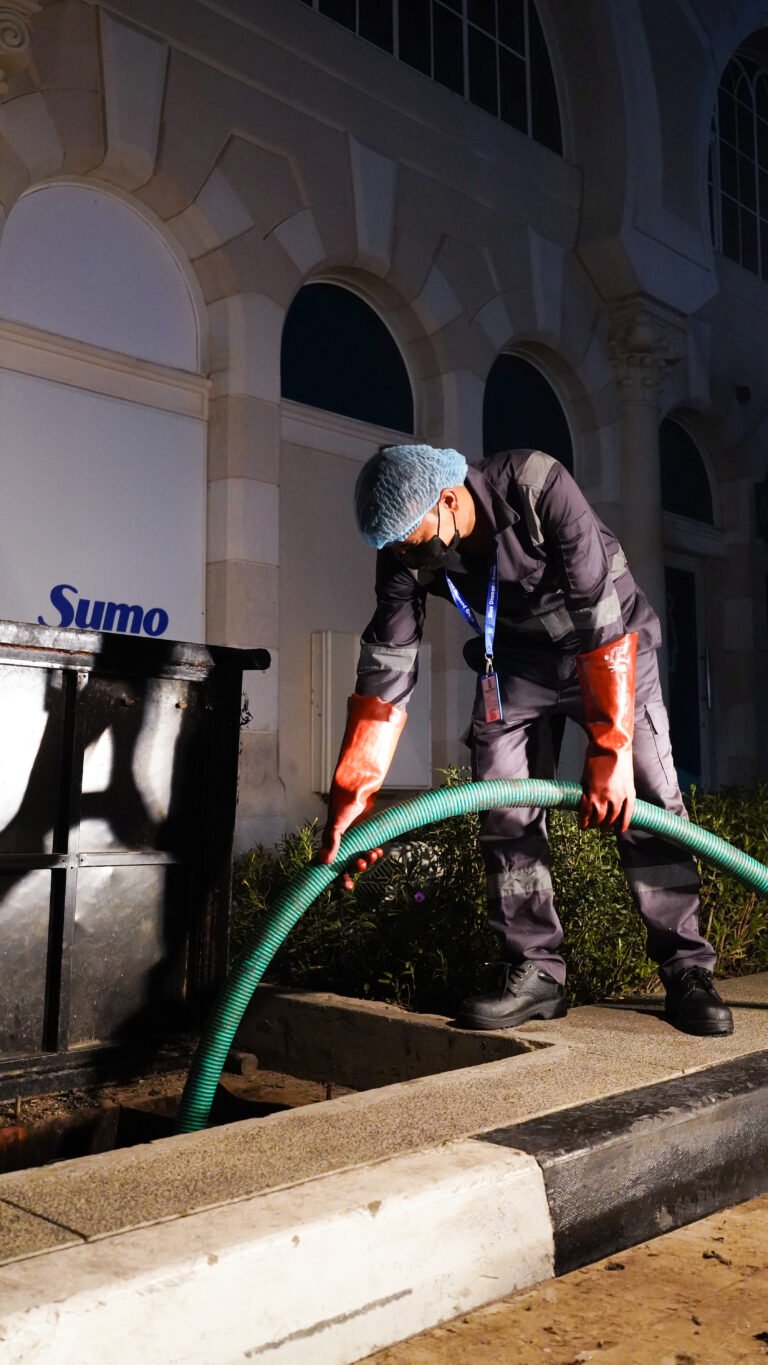
A grease trap — also known as a grease interceptor — is a plumbing device installed in commercial kitchens to capture fats, oils, and grease (FOG) before wastewater enters the municipal sewer system. When FOG enters the drainage network untreated, it solidifies, blocks pipes, causes sewer overflows, and damages expensive municipal infrastructure.
In a country like the UAE, where rapid urban development and a world-class hospitality sector intersect, managing FOG waste is both an environmental and an infrastructure priority. Both Dubai and Abu Dhabi have invested heavily in modern water and drainage systems, and protecting those systems from FOG contamination is a core regulatory focus for both emirates.
The two governing bodies you need to know
Dubai’s grease trap regulations are primarily administered by Dubai Municipality (DM) in coordination with the Dubai Electricity and Water Authority (DEWA). Abu Dhabi’s grease trap framework falls
under the Abu Dhabi Agriculture and Food Safety Authority (ADAFSA), the Abu Dhabi Department of Energy (ADDED), and the Abu Dhabi Distribution Company (ADDC).
These are entirely separate regulatory bodies with separate rules, inspection processes, and penalty structures. This is the root cause of confusion for UAE restaurant owners — especially those operating in both emirates.
What Is a Grease Trap and Why It Matters for UAE Restaurants

Grease Trap Regulations in Dubai: Dubai Municipality Guidelines
Dubai is home to over 20,000 licensed food-and-beverage establishments, making it the most demanding regulatory environment for restaurant grease trap compliance in the UAE. The grease trap regulations in Dubai are governed primarily by Dubai Municipality’s Technical Regulations and Specifications for Commercial Kitchens, with enforcement support from DEWA on the wastewater side.
Governing authority and legal framework
Dubai Municipality is the primary authority for grease trap regulation in Dubai. All commercial kitchen facilities — including restaurants, hotels, cafeterias, school canteens, and hospital kitchens — must comply with DM’s approved standards for grease trap installation, sizing, and maintenance. DEWA enforces compliance on the drainage discharge side, with the authority to inspect and penalise businesses whose wastewater exceeds permissible FOG concentration limits.
Mandatory grease trap size requirements in Dubai
Dubai Municipality calculates the required grease trap capacity based on the number of meals served per day or the seating capacity of the establishment. The minimum sizing formula factors in peak meal volumes, the type of cooking (frying-heavy kitchens generate more FOG), and the volume of wastewater discharged daily. As a general rule, larger restaurants and hotels with high meal turnover are required to install larger interceptors, sometimes ranging from 500 liters to several thousand liters. Businesses must submit grease trap sizing plans to Dubai Municipality for approval prior to installation.
Cleaning frequency requirements in Dubai
Grease trap cleaning frequency in Dubai is mandatory and tied to the size and output of the establishment. Dubai Municipality requires that grease traps be professionally cleaned and maintained on a regular schedule — failure to maintain documented service records is treated as a compliance violation even if the trap itself appears functional.
|
Establishment Size |
Min. Cleaning Frequency |
Fine for Non-Compliance |
|
Small (up to 50 seats) |
Every 3 months |
AED 5,000 – AED 10,000 |
|
Medium (50–150 seats) |
Every 2 months |
AED 10,000 – AED 25,000 |
|
Large (150+ seats / hotels) |
Every 1 month |
AED 25,000 – AED 50,000 |
Licensed service providers in Dubai
Dubai Municipality maintains a list of approved, DM-licensed grease trap service providers. Restaurants must use only these approved contractors — using an unlicensed company, or attempting to clean the trap in-house without proper certification, constitutes a regulatory violation. After each service, your contractor must provide a waste disposal manifest and a signed service certificate, both of which must be retained on-site for DM inspection purposes.
Penalties for non-compliance in Dubai
Penalties under the grease trap regulations in Dubai range from AED 5,000 for a first-time minor violation up to AED 50,000 for serious or repeated breaches. Dubai Municipality inspectors carry the authority to issue immediate improvement notices, order temporary closure, and — in severe cases — recommend license suspension to the Department of Economic Development. All violations are logged in the business’s compliance record and may affect future license renewals.
Grease Trap Regulations in Abu Dhabi: ADAFSA, ADDED & ADDC Standards
Abu Dhabi has built one of the most robust food safety and environmental compliance frameworks in the Gulf region. The grease trap regulations in Abu Dhabi are administered by a multi-authority structure: ADAFSA sets the food safety and hygiene standards, ADDED governs environmental protection and wastewater discharge, and ADDC manages drainage infrastructure compliance. Restaurant owners in Abu Dhabi must satisfy all three authorities.
Governing authority and legal framework
In Abu Dhabi, grease trap compliance is embedded within both the Food Safety Law (Abu Dhabi Law No. 2 of 2008) and the Environmental Standards for wastewater discharge. ADAFSA-registered food establishments are required to have functional, compliant grease traps as a condition of their food license. ADDED and ADDC can issue separate enforcement actions related to environmental discharge violations — meaning a non-compliant restaurant in Abu Dhabi can face penalties from multiple authorities simultaneously.
Grease trap installation standards in Abu Dhabi
Abu Dhabi uses a kitchen output-based sizing methodology, calculating required grease trap capacity in liters per hour of wastewater generated during peak kitchen hours. This approach is more technically demanding than Dubai’s seat-based system and often requires restaurants to engage a licensed environmental consultant to prepare their sizing report for ADDED approval. The standards are particularly strict for hotels, large banqueting kitchens, and industrial catering facilities.
Mandatory servicing schedules in Abu Dhabi
Abu Dhabi mandates more frequent grease trap cleaning than Dubai for medium and large establishments. ADDED requires that service records be maintained digitally and submitted to the TAMM government portal in some categories of food business. Approved waste collection companies must be registered with ADDED to carry out services legally in Abu Dhabi.
|
Kitchen Output |
Min. Cleaning Frequency |
Fine for Non-Compliance |
|
Up to 100 L/hr output |
Every 2 months |
AED 5,000 – AED 20,000 |
|
100–300 L/hr output |
Every 6 weeks |
AED 20,000 – AED 50,000 |
|
300+ L/hr / industrial |
Every 1 month |
AED 50,000 – AED 100,000 |
The Abu Dhabi inspection process
Abu Dhabi inspections are typically conducted by joint ADAFSA and municipality teams. Inspectors will check the physical condition of the grease trap, review service records and disposal manifests, test wastewater discharge for FOG concentration, and verify that the service contractor used is ADDED-registered. Businesses that fail inspections receive a non-compliance notice with a mandatory rectification deadline — usually 7 to 14 days — before a follow-up inspection determines whether penalties are applied.
Penalties in Abu Dhabi
The penalty structure for grease trap violations in Abu Dhabi is notably higher than in Dubai, particularly for industrial-scale operations. Fines range from AED 5,000 to AED 100,000, with immediate license suspension possible in cases where wastewater discharge is found to have caused damage to public drainage infrastructure. Abu Dhabi also has the authority to issue environmental liability orders, requiring the business to fund remediation of any contamination caused.
Grease Trap Regulations in Dubai vs Abu Dhabi: Key Differences at a Glance
When comparing grease trap regulations in Dubai vs Abu Dhabi, it becomes clear that while both emirates share the same fundamental objective — preventing FOG contamination of public drainage — the specific rules, calculation methods, and enforcement mechanisms are meaningfully different. For any UAE restaurant operating in both markets, or planning to expand, understanding these differences is essential.
The table below summarises the key regulatory differences across grease trap regulations in Dubai vs Abu Dhabi for quick reference:
|
Category |
Dubai |
Abu Dhabi |
Key Difference |
|
Governing Body |
Dubai Municipality (DM) + DEWA |
ADAFSA + ADDED + ADDC |
Both differ |
|
Trap Size Standard |
Based on seats & daily covers |
Based on kitchen output (L/hr) |
Different calc methods |
|
Min. Cleaning Freq. |
Every 1–3 months |
Every 1–2 months |
Abu Dhabi stricter |
|
Approved Contractors |
DM-licensed providers only |
ADDED-registered companies only |
Emirate-specific lists |
|
Inspection Authority |
Dubai Municipality inspectors |
ADAFSA + Municipality teams |
Dual authority in AD |
|
Fine Range |
AED 5,000 – AED 50,000 |
AED 5,000 – AED 100,000 |
Abu Dhabi higher ceiling |
|
License Suspension |
Yes — on repeat violations |
Yes — immediate on severe cases |
Both enforce strictly |
|
Online Portal |
DM Business Portal |
Different platforms |
What is stricter in Abu Dhabi?
When reviewing grease trap regulations in Dubai vs Abu Dhabi, Abu Dhabi emerges as the stricter emirate in terms of maximum financial penalties (up to AED 100,000 vs AED 50,000 in Dubai), cleaning frequency for medium-to-large kitchens, and the multi-authority enforcement structure that can result in simultaneous penalties from ADAFSA, ADDED, and ADDC.
What is stricter in Dubai?
Dubai’s seat-based sizing methodology can result in larger minimum trap sizes for high-turnover restaurants than Abu Dhabi’s output-based calculation for equivalent operations. Dubai Municipality’s inspection frequency is also notably high in certain commercial zones such as Downtown Dubai, Dubai Marina, and Deira, where restaurant density is greatest.
How to Stay Compliant: Step-by-Step Checklist for UAE Restaurants
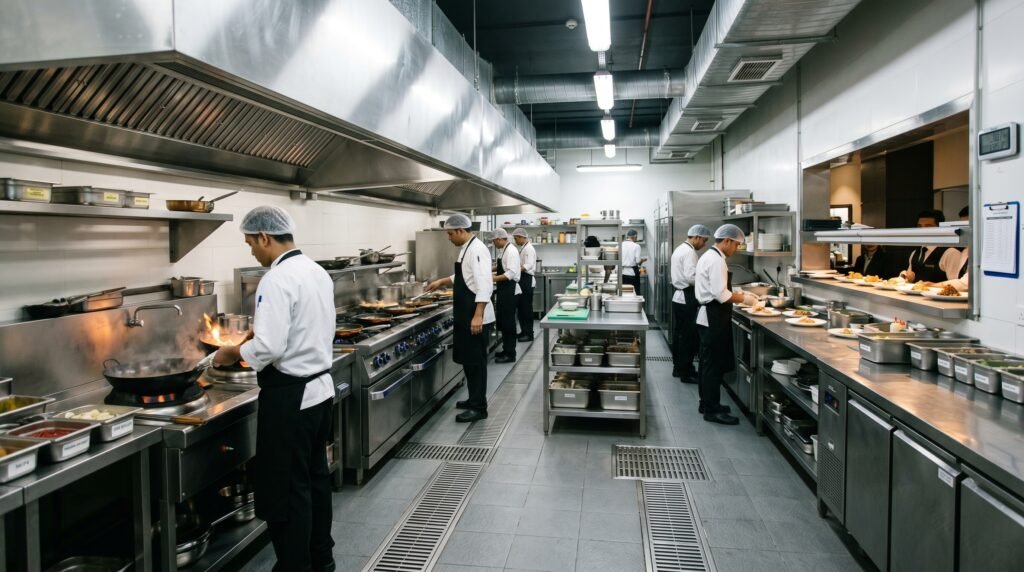
Whether you operate in Dubai, Abu Dhabi, or both, the following step-by-step compliance process will help you stay on the right side of the grease trap regulations across the UAE.
Step 1 — Assess your kitchen and calculate the required trap size
Begin with a professional kitchen assessment. Document your daily meal output or seating capacity (for Dubai) or peak wastewater generation in litres per hour (for Abu Dhabi). Engage a licensed consultant or compliant service provider to prepare your sizing report in the format required by the relevant authority — DM for Dubai, ADDED for Abu Dhabi.
Step 2 — Install an approved grease trap
Ensure your grease trap is installed by an authorised contractor using equipment that meets the technical specifications of the governing authority in your emirate. Submit installation plans and receive written approval before the unit goes live. A grease trap installed without prior approval may not be recognised as compliant even if it meets all size requirements.
Step 3 — Appoint a licensed service provider
- In Dubai: verify your contractor appears on Dubai Municipality’s approved service provider list.
- In Abu Dhabi: verify your contractor is registered with ADDED for grease waste collection.
- Request copies of the contractor’s current approval certificates before signing any service agreement.
Step 4 — Schedule and document regular cleaning
Set up a recurring cleaning schedule that meets or exceeds the minimum frequency required for your establishment size in your emirate. After every service, collect and file the waste disposal manifest and signed service certificate. Store these documents on-site and maintain a digital copy — inspectors can request up to 12 months of historical records.
Step 5 — Register on the relevant authority portal
Dubai businesses should ensure their grease trap compliance status is reflected in the Dubai Municipality Business Portal. Abu Dhabi businesses should register their grease trap service schedule on the TAMM portal where required. Keeping your records digitally updated reduces inspection risk and speeds up license renewal processes.
Prevention Checklist: Avoiding Grease Trap Problems in UAE Kitchens
Common Violations and How UAE Restaurants Get Caught
The majority of grease trap violations uncovered during UAE inspections fall into a predictable set of categories. Understanding these common pitfalls can help your business avoid costly penalties, regardless of whether you are subject to the grease trap regulations in Dubai or the grease trap regulations in Abu Dhabi.
The 5 most common grease trap violations in the UAE
- No valid service records on-site — inspectors arrive and the restaurant cannot produce documentation of the last service.
- Using an unlicensed or unapproved contractor — the service was carried out, but the company is not on the DM or ADDED approved list.
- Trap undersized for actual kitchen output — the installed trap is too small for current volumes, causing frequent overflow.
- Grease trap not cleaned within the mandated period — records show the last service was beyond the required interval.
- Wastewater FOG levels exceeding permissible limits — detected during discharge testing by DEWA or ADDC.
A critical point that catches many multi-location operators: violations are recorded against the food license and can affect permit renewals not just for the offending location, but in some cases across all registered outlets under the same trade license. This is particularly relevant when comparing grease trap regulations in Dubai vs Abu Dhabi, as a violation record in one emirate can flag your business during cross-emirate regulatory checks.
Stay Compliant, Stay Open
The grease trap regulations in Dubai vs Abu Dhabi represent two distinct compliance frameworks — same objective, different rules. Dubai’s Dubai Municipality-led model focuses on seat-based sizing and DM-licensed contractor networks, with fines up to AED 50,000. Abu Dhabi’s multi-authority ADAFSA/ADDED system uses output-based calculations, mandates more frequent servicing in many cases, and carries a higher maximum fine ceiling of AED 100,000.
For UAE restaurant owners and F&B operators, the message is clear: compliance is not a one-size-fits-all matter. You must understand the specific rules for each emirate where you operate, use only approved contractors, maintain rigorous service documentation, and stay registered on the relevant authority portals.
The cost of non-compliance — fines, forced closures, license revocations — far exceeds the cost of a properly managed grease trap maintenance program. The good news: with the right partner, staying compliant is straightforward.
Get a free UAE grease trap compliance assessment today:
- Our certified team covers Dubai, Abu Dhabi, Sharjah, and all UAE emirates.
- We handle sizing assessments, installations, regular servicing, and full documentation.
• DM-licensed and ADDED-registered — one partner for your entire UAE portfolio
Contact us today on WhatsApp | Call | Email
Phone: +971 55 996 3058
Email: info@bluediamondfm.com
Most Frequently Asked Question
Dubai Municipality calculates minimum grease trap size based on seating capacity and daily meal output. There is no single universal size — your establishment must submit a sizing plan to DM for approval. As a general guide, mid-size restaurants (50–150 seats) typically require grease interceptors in the range of 500 to 2,000 liters. A licensed consultant or approved service provider can prepare your sizing assessment.
In Abu Dhabi, cleaning frequency is determined by kitchen output. Kitchens generating up to 100 liters per hour of wastewater must be serviced at least every two months. Medium-output kitchens (100–300 L/hr) require cleaning every six weeks. High-output or industrial facilities must be serviced monthly. All services must be conducted by ADDED-registered contractors and documented with disposal manifests.
In Dubai, fines for grease trap violations range from AED 5,000 to AED 50,000, with the possibility of temporary closure orders and license suspension for repeat offenders. In Abu Dhabi, the fine ceiling is higher — reaching AED 100,000 for serious violations — and environmental liability orders can be issued in addition to financial penalties. Both emirates enforce strictly and conduct unannounced inspections.
No. While all UAE emirates require grease trap compliance for commercial kitchens, the specific regulations, sizing methods, governing authorities, and penalty structures differ by emirate. Sharjah, Ajman, Ras Al Khaimah, Fujairah, and Umm Al Quwain each have their own municipal requirements. The most complex and strictly enforced frameworks are those in Dubai and Abu Dhabi, which is why the comparison of grease trap regulations in Dubai vs Abu Dhabi is particularly relevant for UAE F&B businesses.
In Dubai, contact Dubai Municipality's Environmental Health Department or check the approved contractor list on the DM Business Portal. In Abu Dhabi, consult the ADDED-registered waste management company directory available through the TAMM portal. Alternatively, our team at Blue Diamond Grease Trap Cleaning is licensed and approved to operate in both Dubai and Abu Dhabi, and across all other UAE emirates.
In the UAE, grease trap compliance is the sole legal responsibility of the licensed food business operator, not the building owner or landlord. Both Dubai Municipality and Abu Dhabi ADAFSA issue food licenses to the operating business — and it is that license holder who faces fines, improvement notices, and closure orders in the event of a violation. Even if your tenancy agreement states that the landlord is responsible for drainage infrastructure, this does not transfer regulatory liability under UAE food safety and environmental law. If your grease trap was installed by the building owner before you moved in and does not meet current sizing requirements, you — as the operator — are still legally obligated to upgrade it to compliance standard before trading. Always request a grease trap compliance certificate from your landlord as part of your lease due diligence, and have the unit independently assessed by a licensed service provider before opening.
Our Services
Our step-by-step guide simplifies the cleaning process, ensuring a hassle-free experience while keeping your traps clean.
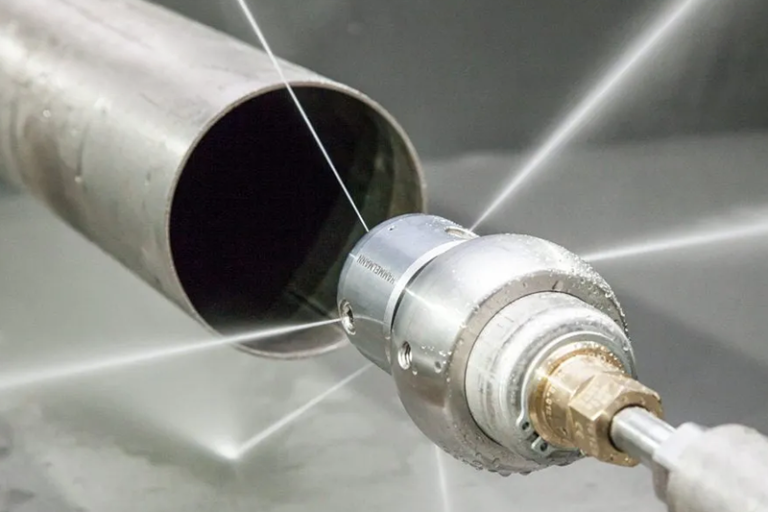
Drain Line Jetting
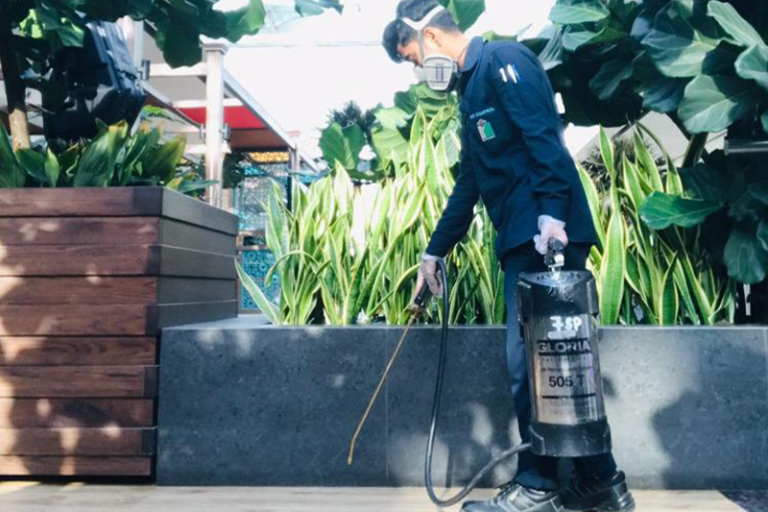
Pest Control Service
Deep Cleaning
business
Our Working Process
Let’s start the journey towards success and enhance revenue for your business. Take your company to the next level.




Why Choose Us
Grease Trap Cleaning UAE
28 years of expertise
Renowned name in facility management
New Technology
We are using latest techniques and technology
Customized Plans
We provide AMC & On call service
Satisfied Clients
40k+ clients trust our expertise
Book An Appointment Today
Blue Diamond would like to hear from you. if you have business inquiries. Get in touch with us.