Automatic Grease Removal Units vs Traditional Grease Traps: What Works for UAE Kitchens
Every commercial kitchen that fries, grills or washes pots needs something between its sinks and the drain to stop fats, oils and grease (FOG) from heading down the pipe. For decades that meant a traditional grease trap: a box or tank that holds the wastewater long enough for grease to float to the top, where it is pumped or scooped out on a schedule. More recently, automatic grease removal units (AGRUs) have arrived, using heaters, skimmers and motors to lift grease out of the water automatically.
Both can work well, and both can fail badly. The right choice depends on your menu, your space, your staff, your building and, in the UAE, your authority and landlord. This guide compares automatic grease removal units vs traditional grease traps side by side, explains where each fits in UAE kitchens, lists the questions to ask before you buy and shows how to run either one properly.
- Traditional traps: (passive hydromechanical units and gravity interceptors) are simple, robust and widely accepted, but they depend on regular, thorough cleaning and pump-outs.
- Automatic units: reduce how often grease has to be emptied by hand and can cut odors, but they need power and daily care, and they have moving parts that fail if neglected.
- Neither is “set and forget:” The best system is the one that matches your kitchen’s output and the one your team will actually maintain.
- Approval matters: Whether a particular unit is accepted depends on the authority, the building and your approved drawings, so confirm before you buy.
-
Maintenance determines performance: Even the most advanced grease management system will underperform if inspection schedules, cleaning routines, and staff responsibilities are not consistently followed.
-
Lifecycle costs matter: The purchase price is only one part of the equation. Labor costs, cleaning frequency, repairs, downtime, and waste disposal expenses should all be considered when selecting a grease management solution.
-
Training is essential: Kitchen staff should know how the system operates, recognize early warning signs of problems, and understand when maintenance or servicing is required.
-
Compliance protects operations: Regular inspections, documented maintenance, and proper grease management practices help prevent drain blockages, reduce environmental risks, and support compliance with local regulations and authority requirements.
The Short Answer
Manufacturers offer three types of grease interceptor: automatic, hydromechanical and gravity, all designed to collect FOG and available in sizes to suit different outputs.
| Type | What It Is | Typical Setting |
|---|---|---|
| Passive hydromechanical trap | A compact box, often plastic or stainless steel, that slows wastewater and separates grease by gravity and flow control. Cleaned manually. | Small to medium kitchens, under-sink or in-kitchen installations |
| Gravity grease interceptor | A large in-ground tank in concrete, fibreglass or steel that works like a passive trap but has a much larger capacity, suiting high-flow applications. Pumped out on a schedule. | Large restaurants, hotels, food courts, canteens and central kitchens |
| Automatic grease removal unit (AGRU) | A hydromechanical unit with added components such as baffles, screens and external FOG collection containers, with some also featuring heaters, skimmers, pumps or pressure chambers. | Medium to high-volume kitchens where space is limited |
The Main Types at a Glance
Traditional Grease Traps Explained
Passive (Hydromechanical) Traps
Wastewater enters a chamber where baffles slow the flow. Grease floats, solids settle and relatively clear water leaves through the outlet. They are usually installed inside the kitchen or under a sink. They have no moving parts or electrical supply, which makes them simple and reliable, but the grease and solids have to be removed by hand, often.
Gravity Interceptors
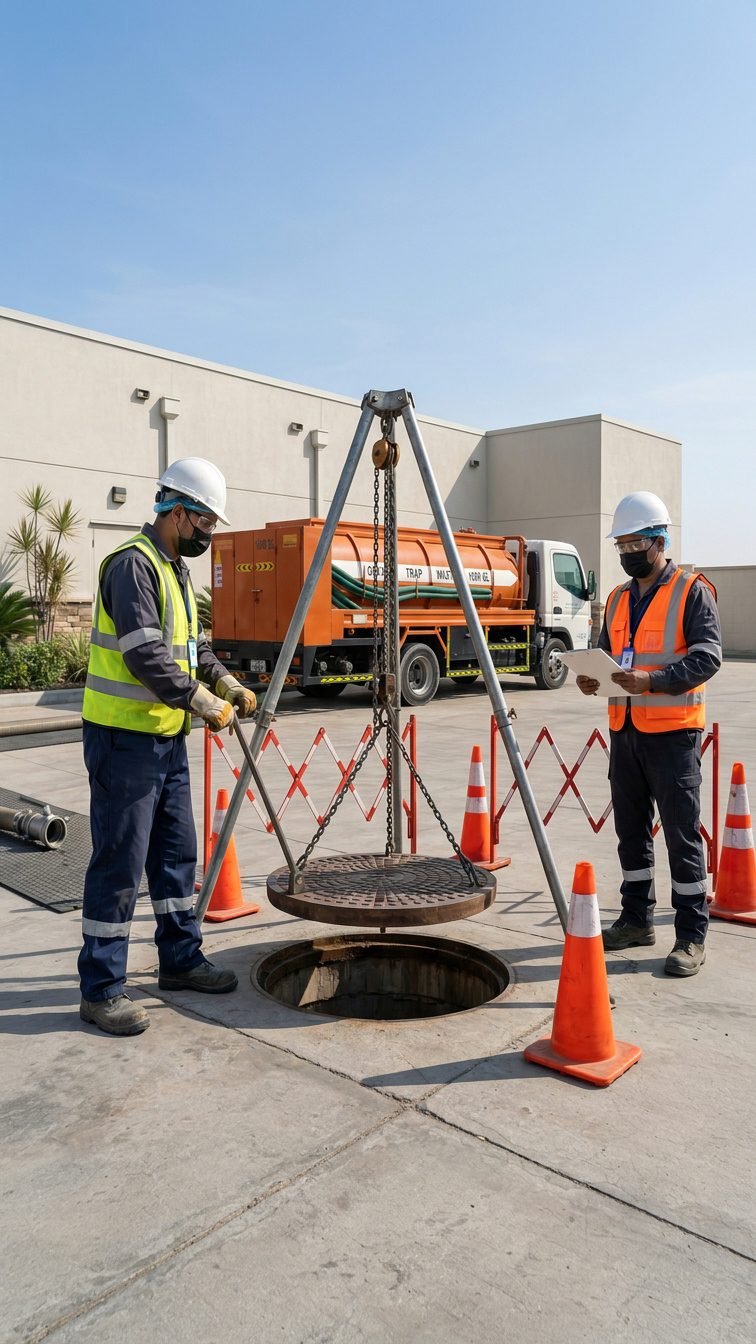
These are much larger tanks, often installed outside the building or in a basement. Because their tanks have a much larger capacity, gravity traps are serviced less frequently than automatic or hydromechanical units. They are pumped out by a specialist contractor on a scheduled basis. Corrosion is the main long-term issue, particularly in concrete or metal tanks.
Strengths
- Simple, proven and widely understood
- No electrical supply or moving parts in passive units
- Large gravity tanks give high capacity and long service cycles
- Often the default accepted by authorities and landlords
Weaknesses
- Passive units need frequent, thorough cleaning, and shortcuts such as skimming the surface leave the baffles overloaded
- Poorly maintained traps smell
- Large tanks need space and access for pumping trucks
- Under-sized traps fill quickly and fail
Automatic Grease Removal Units Explained
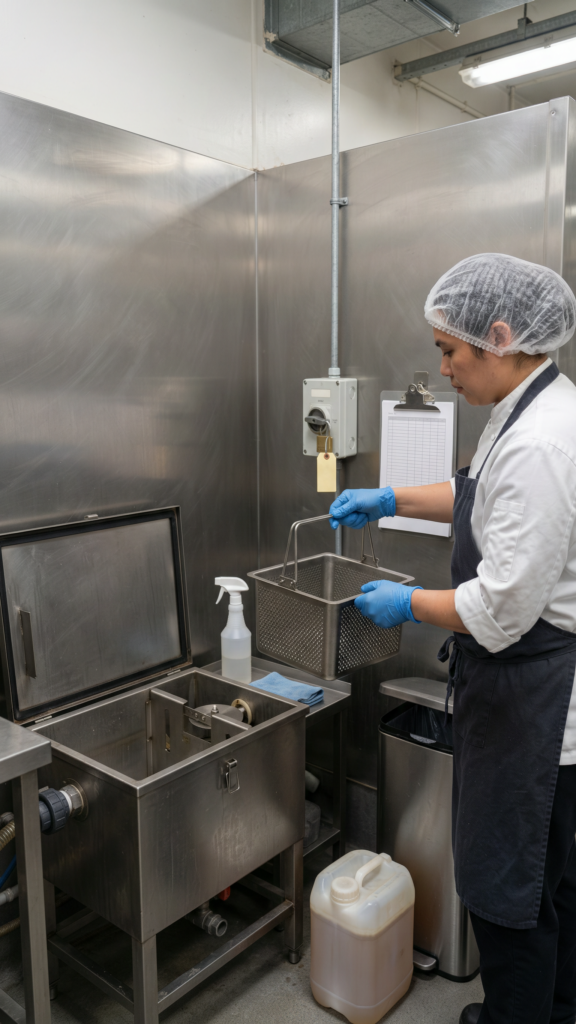
An AGRU works like a passive trap but adds automation. It reheats and skims the FOG out automatically on a programed schedule, usually into an external container that staff or a contractor empty. Typical features include a heating element, a motorized skimmer, filters or screens and a collection container.
AGRUs are generally certified to recognized performance standards, such as ASME A112.14.4 or PDI G-101, and they are sized for the flow of the fixtures connected to them and installed with ready access for inspection and maintenance.
Strengths
- Automatic removal of grease reduces how often a trap must be pumped or scooped by hand
- Can reduce odor, because grease is removed before it decomposes in the tank
- Compact, suited to kitchens with limited space
- Useful where frequent manual cleaning is difficult or poorly done
Weaknesses
- They need electricity: and a power cut or fault stops the automatic function
- They need daily care: AGRUs typically require intervention by facility personnel on a frequent, usually daily, basis, and most automatic units need food particles and sediment cleaned out of their filters each day.
- Moving parts and heaters fail if neglected: Because they include skimmers, heating elements and circuitry, automatic units are more likely to fail from lack of maintenance.
- They cost more upfront than a passive trap
- They still produce FOG waste that must be disposed of through an authorised collector
- They still need professional servicing, inspection and parts
Side-by-Side Comparison
| Factor | Passive Hydromechanical Trap | Gravity Interceptor | Automatic Grease Removal Unit |
|---|---|---|---|
| How grease is removed | Manually | By pump-out | Automatically skimmed into a container, then emptied |
| Power needed | No | No | Yes |
| Space required | Small | Large (tank, access for trucks) | Small to medium |
| Daily staff involvement | Low, but frequent thorough cleaning needed | Low | Moderate to high (filters, container) |
| Service frequency by contractor | Frequent | Less frequent | Periodic, plus servicing of moving parts |
| Odor risk | Higher if cleaning is late | Lower between pump-outs, can be high if overdue | Lower if well maintained |
| Upfront cost | Lowest | Highest installation effort | Higher than passive |
| Running cost | Frequent cleaning | Pump-out charges | Power, spare parts, servicing, FOG container disposal |
| Failure risk | Overload from missed cleaning | Corrosion, overdue pumping | Mechanical or electrical faults, neglected daily care |
| Best for | Small to medium kitchens with disciplined cleaning | High-volume, high-flow kitchens with space | Space-limited kitchens with a trained, consistent team |
What Matters Most in the UAE
Heat and Odor
High temperatures speed up grease breakdown and odor. A neglected passive trap in a hot back-of-house area or a poorly ventilated tower podium can become a complaint very quickly. Automation can help, but only if the unit and its container are cleaned on schedule.
Space in Towers and Podium Kitchens
Many UAE restaurants operate in tower podiums, malls and compact units where there’s no room for a gravity tank and limited access for pumping trucks. Compact units, including AGRUs, can make sense in those settings, but the landlord and building management usually have a say. See our guides to grease trap cleaning in JLT, Dubai Marina & JBR and in Business Bay & Downtown.
Power Quality and Reliability
Automatic units depend on power. Surge protection, correct electrical installation and a plan for what happens during a power cut all matter. An AGRU that has stopped working silently is effectively a blocked pipe waiting to happen.
Staffing and Training
Staff turnover is high in many kitchens. A system that depends on a daily routine will fail if new team members aren’t trained and supervised. Passive and gravity systems are more forgiving of changes in staff, because most of the work is done by the contractor on a schedule.
Approvals, Landlords and Shared Drainage
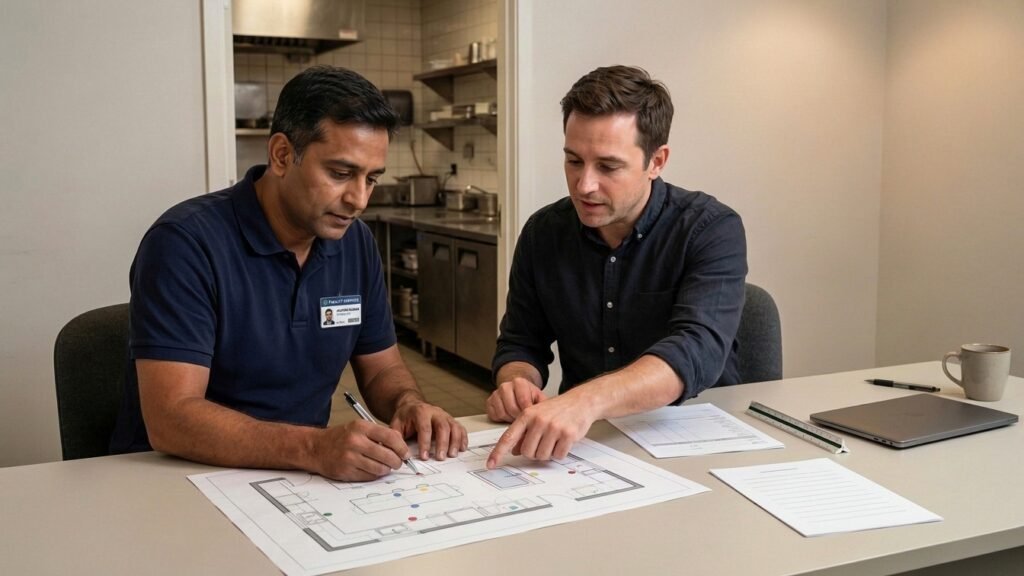
Whether an automatic unit is accepted depends on your authority, your building’s fit-out manual and your approved drawings. In many buildings there’s also a central interceptor downstream that the landlord controls. Ask in writing whether the building and the authority accept the type you plan to install, and who is responsible for the shared lines. Our guides to grease trap rules in UAE free zones and to grease trap maintenance in shopping malls explain how these layers fit together.
Waste Disposal
Whatever you install, the grease that’s removed must be collected and disposed of by an authorized provider, with records. An automatic unit changes who handles the grease and how often, not whether it needs proper disposal.
Which Suits Which Kitchen?
| Kitchen Type | Often Suits | Why |
|---|---|---|
| Small café or bakery with low grease output | Passive hydromechanical trap on a regular service schedule | Simple and low-cost, with modest grease loads |
| Mid-size restaurant in a tower podium with tight space | Compact passive unit or an AGRU, subject to approval | Limited room, with a disciplined team needed for an AGRU |
| High-volume fried, grilled or shawarma outlet | Larger hydromechanical unit or gravity interceptor, sometimes with an AGRU upstream | High grease load and frequent service needs |
| Hotel main kitchen and banqueting | Gravity interceptor, often with in-kitchen units | Large volumes and peaks |
| Mall food-court unit | Whatever the landlord’s fit-out manual specifies, often compact units plus a central interceptor | Shared drainage and building rules |
| Central production kitchen, canteen or labour accommodation kitchen | Gravity interceptor, sometimes with automatic pre-treatment | Very high, steady grease output |
| Cloud kitchen with several brands | Sized for the combined output, with frequent service | Multiple fryers sharing one line |
These are starting points, not rules. A proper assessment looks at your actual flow, fixtures, menu and building.
A Hybrid Approach
Many kitchens combine the two ideas:
- An AGRU or compact unit close to the fixtures to remove most grease early and reduce odor
- A trap or interceptor downstream as a second line of defense
- Good kitchen practice upstream, including dry-wiping, strainers and used-oil collection
- A scheduled service plan that covers all components
Dry-wiping kitchenware is generally recognised as the most important preventive step, and overusing detergents and degreasers can emulsify grease and reduce a trap’s efficiency, so the way a kitchen works matters as much as the hardware
Sizing and Installation Essentials
For any system, get these right:
- Size for measured or calculated flow: of all connected fixtures. For automatic units, they are located downstream of the fixtures they serve and sized to the flow of everything connected, with ready access for inspection and maintenance.
- Route every grease-producing fixture: through the system, including pot sinks, pre-rinse sinks, dishwashers and floor drains
- Provide safe, ready access: for cleaning, servicing and pumping
- Install to the manufacturer’s instructions: and the approved drawings
- Provide a safe electrical supply: for automatic units, with surge protection
- Set up alarms and checks: where the system allows them
- Commission and train staff: before the kitchen opens
Operating Routines
For Automatic Units
- Daily: clean filters and screens, empty the grease container as required and check the unit is running
- Weekly: check heaters, skimmers and seals for wear, and inspect for leaks or odor
- Monthly or as advised: professional inspection, with a deeper clean
- Always: keep records, and call a technician at the first sign of a fault
For Traditional Traps
- Daily: dry-wipe, use strainers and watch for slow drains or odor
- Scheduled: full pump-out, scraping, flushing and inspection, at an interval matched to your output- see our guides to annual grease trap maintenance plans and the signs your grease trap needs cleaning.
- Always: keep service and disposal records
Common Mistakes
- Choosing on price alone: without checking approvals, space, power and staffing
- Installing an AGRU and assuming the problem is solved: then skipping the daily routine
- Undersizing the unit: for the real flow, so it fails during busy periods
- Ignoring the landlord’s central interceptor: which may still need regular service
- Relying on chemical or enzyme products: instead of proper cleaning
- Forgetting disposal documentation: for the removed grease
- Not planning for power cuts, surges or spare parts
- Letting staff skim the surface: of a passive trap instead of cleaning it properly
- Never reviewing the system: when the menu, volumes or building change
Compliance and Records
Whatever you choose, inspectors and building managers will look for the same evidence:
- A correctly sized, approved and accessible unit
- A cleaning or servicing schedule, followed and recorded
- Dated service reports and disposal records
- The contractor’s license and insurance details
- Records of repairs, parts and daily checks (for automatic units)
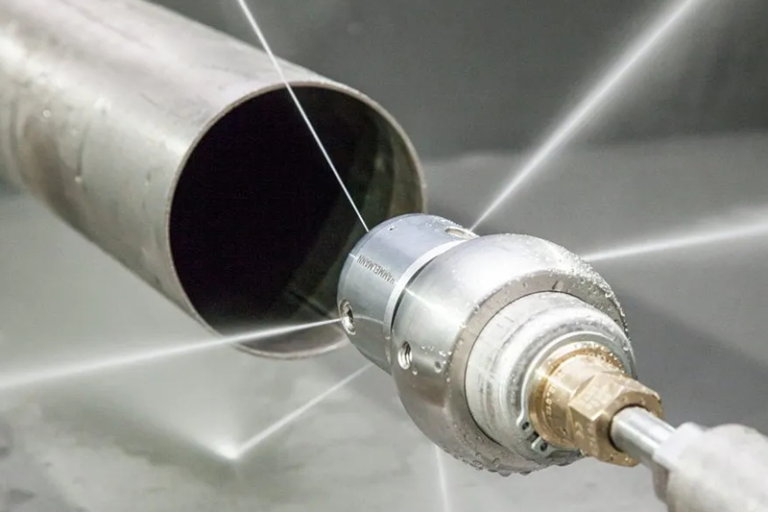
Our UAE restaurant compliance checklist covers the wider set of kitchen records, and our guide to CCTV drain survey and high-pressure jetting explains how to check the drain lines downstream of any system.
Questions to Ask Before You Decide
- Will the authority and the landlord accept this type of unit, and can I have that in writing?
- What flow rate is it rated for, and how was it sized for my kitchen?
- Which standards is it certified or tested to?
- What power does it need, and what happens in a power cut?
- What daily and weekly tasks will my team need to carry out?
- What does professional servicing involve, how often and what does it cost?
- How are spare parts supplied, and how quickly in the UAE?
- Where does the removed grease go, and who collects it?
- Can I see a similar installation in a comparable kitchen?
- What warranty and support do I get?
Choose the System You Can Actually Maintain
The debate over automatic grease removal units vs traditional grease traps usually ends with the same conclusion: the best system is the one that’s correctly sized, properly approved, suited to your space and staff, and serviced on a schedule you can prove. Automation can help, but it never replaces good kitchen habits, regular professional servicing and authorised disposal.
Book a free grease trap assessment today with Blue Diamond team. They will review your kitchen’s flow, space and building requirements, advise on the right type of unit and set up a documented service plan with authorized disposal, for restaurants, hotels and food businesses across the UAE.
Contact us today on WhatsApp | Call | Email
Phone: +971 55 996 3058
Email: info@bluediamondfm.com
Most Frequently Asked Question
Not automatically. An AGRU can reduce manual emptying and odor in the right kitchen, but it needs power, daily care and servicing. A traditional trap or interceptor is simpler and can be more forgiving where staff turnover is high. The better choice depends on your kitchen, space, team and approvals.
They reduce how often grease has to be emptied by hand, but they replace that work with daily tasks such as cleaning filters and emptying the container, plus servicing of moving parts and heaters. Neglect is the main cause of failure.
The automatic functions stop, so the unit behaves less effectively until power returns. Ask the supplier how the unit behaves in an outage, and consider surge protection and a plan for emergency servicing.
Yes. You’ll still need scheduled professional servicing, inspection and parts, and an authorised provider to collect and dispose of the grease that’s removed.
Start with your kitchen’s actual grease output, fixtures and peak flow, then check available space, access, power, staffing, the landlord’s rules and the authority’s requirements. A site assessment by a qualified contractor will give you a reliable answer.
Our Services
Our step-by-step guide simplifies the cleaning process, ensuring a hassle-free experience while keeping your traps clean.
Drain Line Jetting
Pest Control Service
Deep Cleaning
business
Our Working Process
Let’s start the journey towards success and enhance revenue for your business. Take your company to the next level.
Book An Appointment Today
Blue Diamond would like to hear from you. if you have business inquiries. Get in touch with us.