5 Signs Your Commercial Kitchen Needs Grease Trap Cleaning in UAE
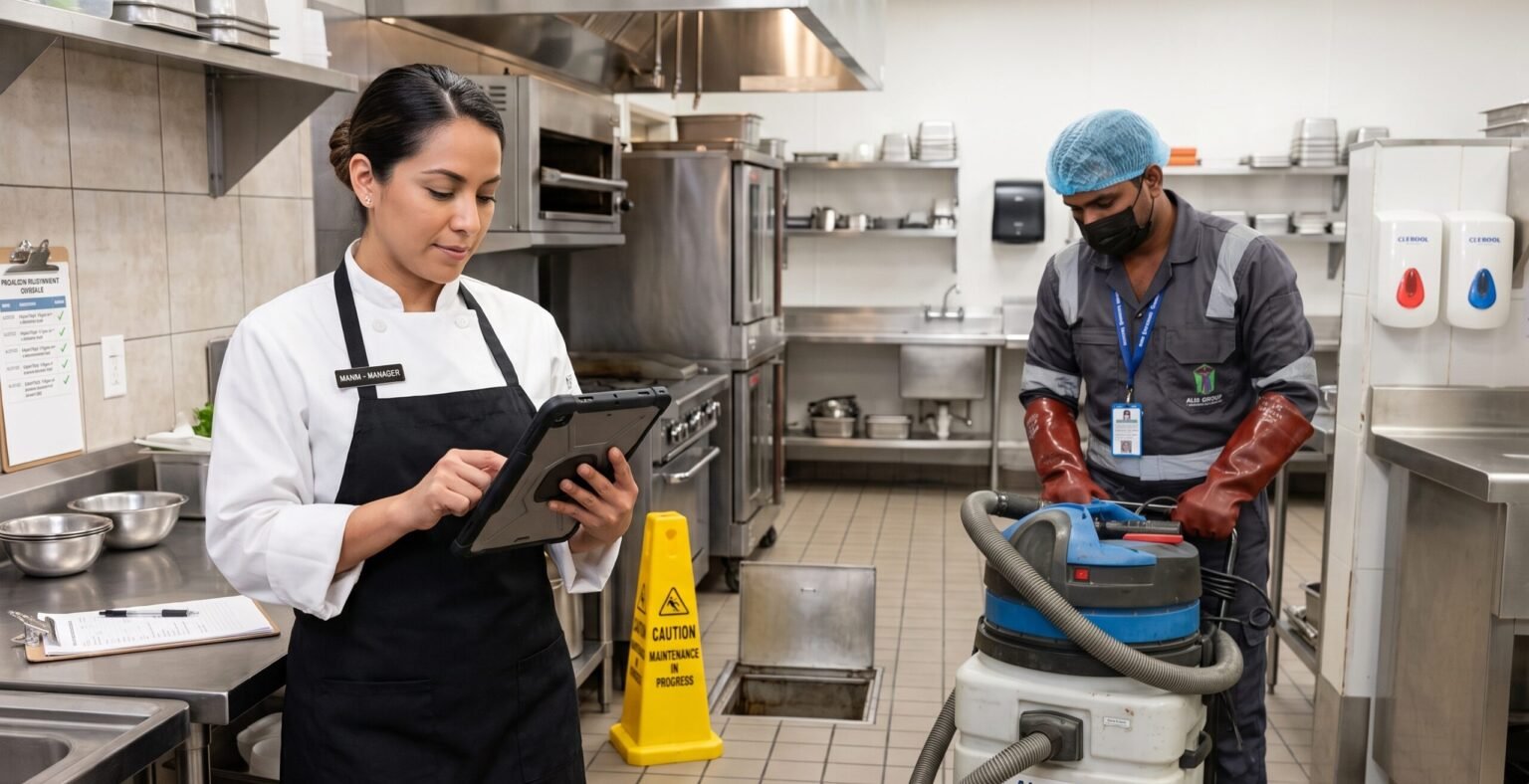
In the most part, commercial kitchen operations in UAE facilities do not have set calendar reminders to schedule their grease trap cleaning in UAE. Instead, they operate on a reactive basis; they schedule the service after a drain clogs up during service, or when a health inspector issues a complaint about odors. At this point, the grease trap is typically long overdue for a routine pumping-out (a process that normally takes approximately 30 minutes) and is now a reactive emergency call-out that will take place during the peak operational hours.
If you pay attention to the traps, they will let you know when they need servicing well before there’s an emergency. There are five warning signs that every restaurant, hotel kitchen and food service manager in the UAE should be able to identify, and what they need to do when those warnings occur.
A grease trap works by allowing wastewater to slow down enough for fats, oils and grease to separate and rise to the surface, and solids to sink. The amount of wastewater that can enter the trap decreases as the trap becomes full, which causes the trap to lose effectiveness in preventing grease from entering the drainage system before the trap actually overflows. Because of the warm climate in the UAE, grease will degrade and accumulate at a higher rate than in other areas with cooler temperatures.
which means the window between “due for cleaning” and “actively causing problems” is often shorter than kitchen managers expect.
Recognising the signs below and scheduling grease trap cleaning in UAE kitchens before they escalate protects three things at once: your drainage system, your food safety compliance standing, and your ability to avoid an emergency service call during peak trading hours.
Why Catching These Signs Early Matters
A sour, rancid or sulphureous smell lingering near floor drains, the dishwashing area or the grease trap access point is usually the earliest warning sign, appearing well before any visible or physical problem develops.
Why it happens? as grease and organic matter accumulate and begin decomposing inside the trap, they produce hydrogen sulphide and other odor-causing compounds. In an enclosed kitchen or a poorly ventilated plant area, this smell becomes noticeable to staff and, eventually, to customers.
It means an occasional faint smell after a busy shift can be normal. A persistent odor that doesn’t clear with routine cleaning, or one that customers or staff comment on, means the trap has accumulated more grease than it can hold without decomposition becoming a problem.
In this case, don’t mask the smell with air fresheners or drain deodorizers, which address the symptom and delay recognition of the underlying cause. Schedule an inspection and pump-out promptly.
Sign 1: Persistent Foul Odors Near Drains or the Kitchen
If dishwashing sinks, pre-rinse stations or floor drains are taking noticeably longer to clear than usual, your grease trap is very likely restricting flow.
So as grease coats the trap’s internal surfaces and hardens, it narrows the effective flow path through the unit, and a full trap has essentially no working capacity left to allow water through at a normal rate. The wastewater backs up upstream, at your sinks and floor drains, before it ever reaches the point where you’d notice the trap itself.
The slow drainage is rarely a one-off issue. It’s a mechanical symptom of a trap operating at or beyond its intended capacity, and it typically gets worse day by day rather than resolving on its own.
if it happened avoid the temptation to pour hot water, degreasers or chemical drain openers down the line to “push it through.” This can temporarily improve flow while making the underlying grease deposit harder and more difficult to remove during proper cleaning. Book service before the drain stops entirely.
Sign 2: Slow-Draining Sinks and Floor Drains
Sign 3: Visible Grease at or Near the Trap Access Point
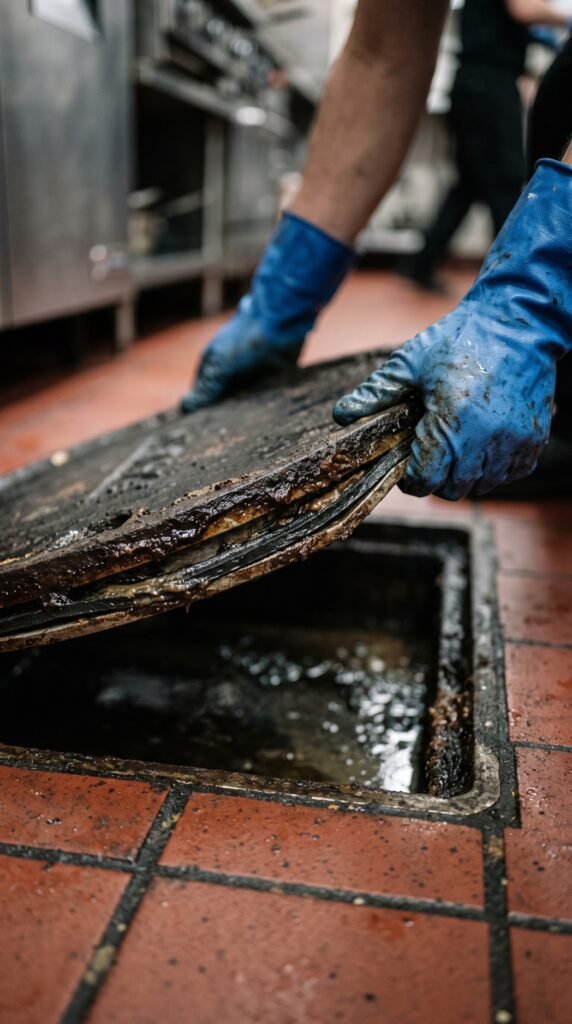
If you lift the trap’s access cover, or if you notice grease residue around the cover seal, on the floor nearby, or backing up into a connected sink, this is a direct visual confirmation that the trap is over capacity.
Why you see it? once the grease layer inside the trap reaches close to the outlet level, any additional discharge pushes grease out through the outlet pipe or back up through connected fixtures, since the trap no longer has room to hold and separate incoming waste properly.
So this sign typically appears later than odor or slow drainage, meaning the trap is significantly overdue. Visible grease at this stage often indicates the unit is at or very close to full capacity.
You should treat this as an urgent booking rather than a routine one. Continuing to operate the kitchen with a visibly overflowing trap risks a sudden blockage during service, and in a shared-building context, risks affecting neighbouring tenants’ drainage too.
Sign 4: Recurring Drain Blockages or Backups
If your kitchen experiences repeated blockages in the same drainage line, particularly ones that seem to resolve temporarily after a plunger or a quick chemical treatment before recurring within days or weeks, an overdue grease trap is a common underlying cause.
What Happend? a trap that’s no longer intercepting grease effectively allows fat and oil to travel further into the drainage line, where it cools and hardens against pipe walls downstream of the trap itself. Clearing the immediate blockage doesn’t address the grease accumulating structurally within the pipe run, so the problem returns.
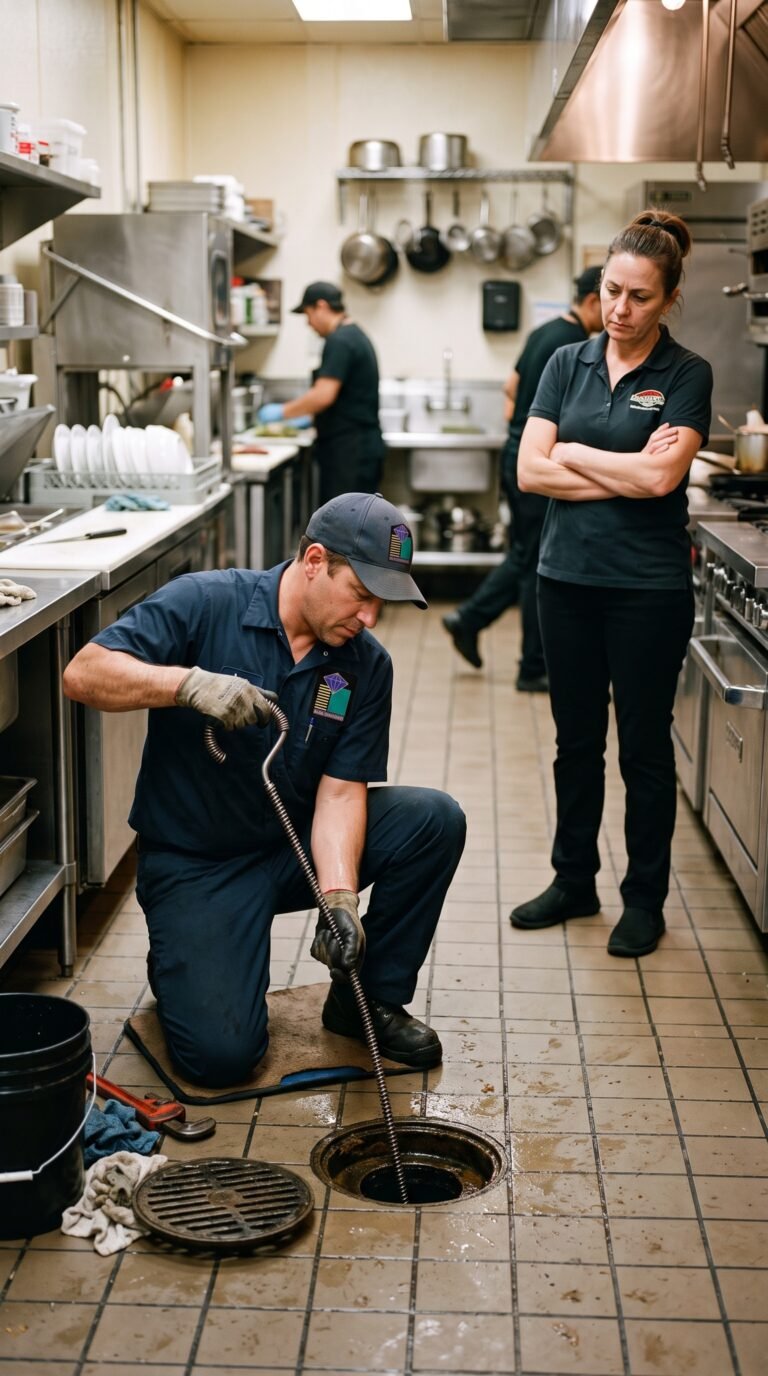
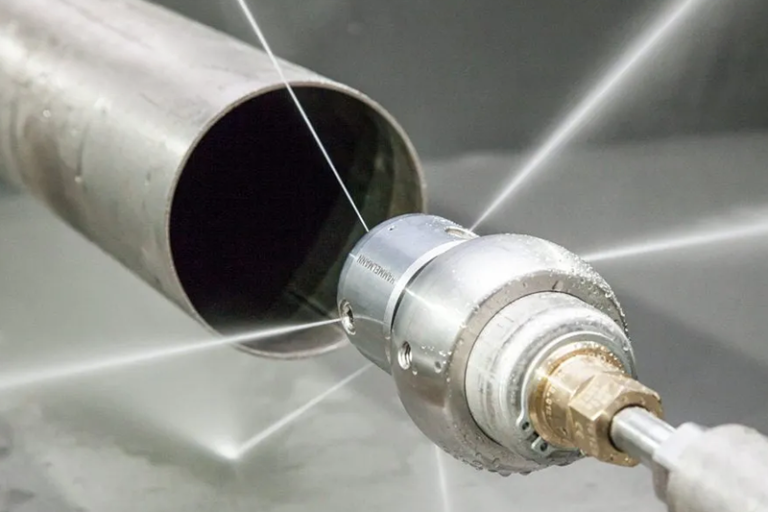
Recurring blockages usually mean the issue has progressed beyond “the trap needs cleaning” to “the downstream pipework may also need attention.” The longer this continues, the more likely a full drain-line clean or jetting service becomes necessary alongside the trap service.
Immediately book a grease trap cleaning in UAE facilities alongside a drain-line inspection if blockages have recurred more than once. Treating only the trap while ignoring an already-affected pipe run means the blockages will likely continue.
Sign 5: It's Been Longer Than Your Recommended Service Interval
The least dramatic sign, and arguably the most important one to track, is simply time. Many kitchens fall out of compliance not because of any visible symptom but because the scheduled service date quietly passed without a booking.
Mainly a busy kitchens deprioritize non-urgent maintenance, particularly when no obvious problem has appeared yet. Without a documented schedule and reminder system, it’s easy to lose track of the last service date.
The recommended intervals exist precisely because visible symptoms lag behind actual capacity. By the time you notice odour or slow drainage, the trap has typically already been overdue for some time. Relying on symptoms alone means you are always reacting after the fact.
If you don’t already have one, set up a documented cleaning schedule based on your kitchen’s grease output (see the table below), and treat the calendar date, not the appearance of a symptom, as your trigger to book service.
| Kitchen Type | Recommended Interval |
|---|---|
| High-volume, fried/grilled cuisine | Every 2–4 weeks |
| Standard full-service restaurants | Every 4–6 weeks |
| Cafés and low-oil-output outlets | Every 6–8 weeks |
| Cloud kitchens with multiple brands | Every 2–4 weeks |
What Happens If You Ignore These Signs
Delaying grease trap cleaning in UAE kitchens past these warning signs typically leads to one or more of the following:
- Emergency call-out costs: usually higher than a scheduled visit and often needed during peak service hours
- Kitchen downtime: while blockages are cleared or the trap is emptied under pressure
- Food safety inspection failures: since exhaust and drainage hygiene are part of most municipal and free-zone inspection criteria
- Damage to shared building drainage: particularly in high-rise or mall units sharing a riser with other tenants
- Insurance complications: if a related drainage failure causes property damage and you cannot produce maintenance records
Don't Wait for the Overflow
These five signs exist on a timeline, and the earlier you act, the cheaper, faster, and less disruptive the fix. Odor and slow drainage are your kitchen telling you the trap needs attention now; visible grease and recurring blockages mean it should have been addressed already.
Book a free inspection today with Blue Diamond technicians, They will assess your trap’s current condition, clear any backlog safely, and set up a documented cleaning schedule so you’re never relying on symptoms to know when service is due, anywhere across the UAE.
Contact us today on WhatsApp | Call | Email
Phone: +971 55 996 3058
Email: info@bluediamondfm.com
Most Frequently Asked Question
Odors and slow drainage warrant booking within a few days. Visible grease at the access point or recurring blockages should be treated as urgent, ideally within 24–48 hours, to avoid a full blockage during service.
Home remedies like hot water or chemical drain openers can temporarily mask the symptom but don't remove the underlying grease accumulation, and chemical treatments can make it harder to clean properly later. They're not a substitute for professional pump-out and cleaning.
If you're experiencing these warning signs significantly more often than the recommended interval suggests you should, your trap may be undersized for your actual output. A contractor can assess this during a site visit and recommend resizing if needed.
Yes, the same warning signs apply regardless of trap type or size, though larger interceptors may take longer to show symptoms simply because they hold more volume before reaching capacity.
A consistent, correctly scheduled cleaning program prevents the vast majority of these issues. Occasional unexpected demand spikes (a large event, a busy season) can still cause symptoms to appear slightly early, which is why monitoring signs alongside your schedule, rather than relying on the calendar alone, gives the best protection.
Our Services
Our step-by-step guide simplifies the cleaning process, ensuring a hassle-free experience while keeping your traps clean.
Drain Line Jetting
Pest Control Service
Deep Cleaning
business
Our Working Process
Let’s start the journey towards success and enhance revenue for your business. Take your company to the next level.
Book An Appointment Today
Blue Diamond would like to hear from you. if you have business inquiries. Get in touch with us.