Grease Trap Cleaning in UAE: The Real Reason Behind Restaurant Odors
If you run a restaurant, a cloud kitchen, a hotel kitchen, or any food establishment in the UAE, you know this smell. That persistent, low-level odor that lingers no matter how often you clean the surfaces, mop the floors, or spray the deodorizers. Customers notice it. Your staff live in it. And if a Dubai Municipality or Abu Dhabi ADCD inspector notices it, you have a very short window before it becomes an official problem.
The cause is almost never what restaurant owners expect. It is not the bins. It is not the drains. It is not even the food itself.
It is your grease trap — and if it has not been professionally cleaned on schedule, it is silently working against you every single day.
This guide explains exactly what is happening, why UAE conditions make it worse than most countries, and what you need to do to fix it — before the next inspection.
A grease trap — also called a grease interceptor — is a plumbing device installed in the drainage system of every commercial kitchen. Its job is straightforward: intercept the fats, oils, and grease (collectively called FOG) that flow off pots, pans, plates, and fryers before that wastewater enters the main sewer system.
Here is the basic principle. FOG is lighter than water. Inside a grease trap, wastewater slows down long enough for the FOG to separate and float to the top, while solids sink to the bottom. The relatively cleaner water in the middle passes through to the sewer. Simple in concept — but only effective when maintained properly.
The rule applies to virtually every food business operating in the UAE:
- Restaurants and cafeterias of all sizes
- Hotel kitchens and banqueting facilities
- Cloud kitchens and dark kitchens
- Hospital, school, and corporate canteens
- Supermarket food preparation areas
- Catering companies and food production facilities
- Mall food courts and kiosks with cooking equipment
If you cook food commercially in the UAE, you almost certainly need a grease trap — and you need it cleaned regularly.
What is a grease trap, and why does UAE law require one?
The real reason behind that persistent restaurant odor
Most restaurant owners blame the smell on drains, bins, or simply the nature of a busy kitchen. This misdiagnosis leads to endless surface cleaning that never actually solves the problem — because the source is underground, inside your grease trap.
The chemistry behind the smell
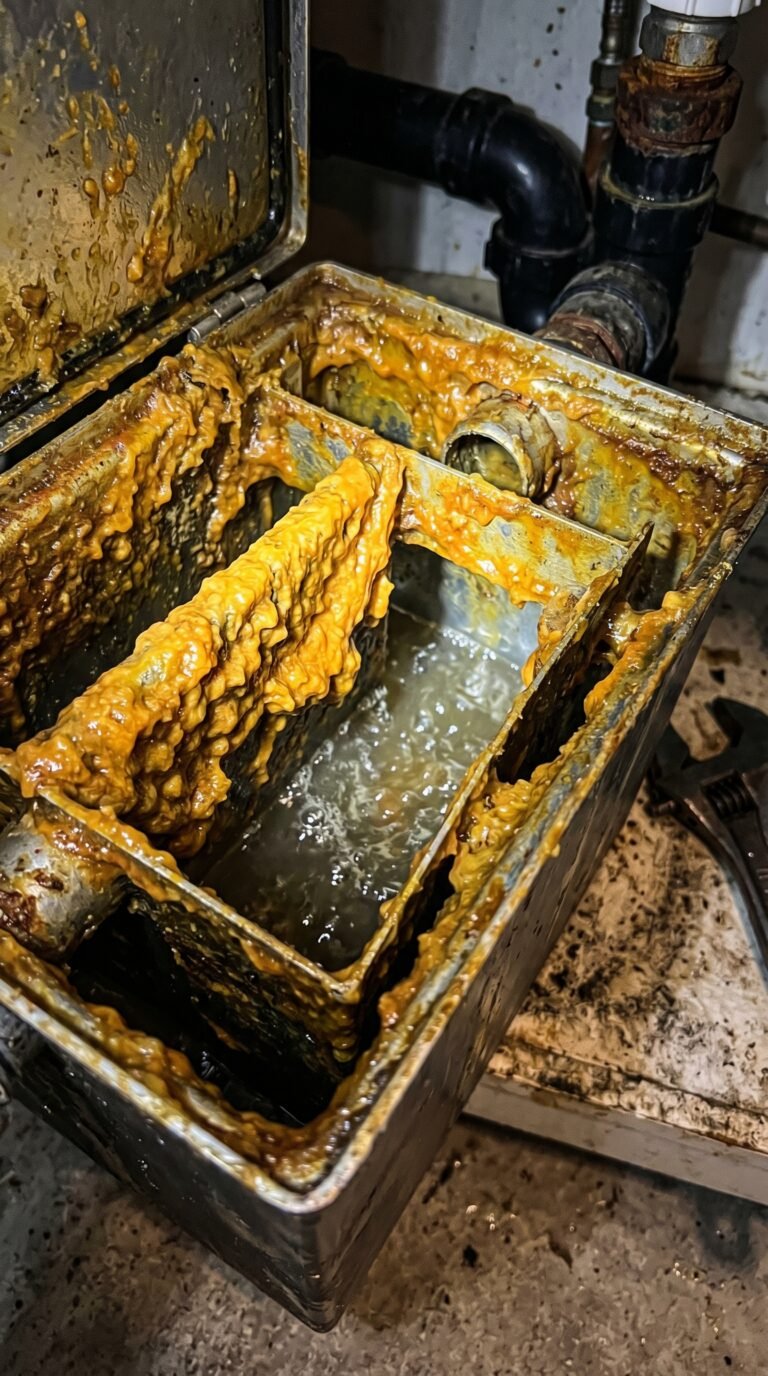
When FOG accumulates inside a grease trap and is left for weeks or months, it begins to decompose. Without oxygen, the bacteria breaking down the organic matter produce hydrogen sulfide gas — the compound responsible for that unmistakable rotten-egg odor.
This gas does not stay in the trap. It travels back up through your drain pipes, emerging at sinks, floor drains, and anywhere connected to the grease trap system. The result: an odor that appears to come from the drain but actually originates from a trap that is 60%, 70%, or 90% full of decomposing grease.
Why UAE makes it significantly worse
International guidelines suggest cleaning grease traps every 3 months. In the UAE, that timeline can be dangerously inadequate.
Here is why. At 40°C to 48°C in a Dubai summer, the ambient temperature inside a commercial kitchen can push even higher. Heat dramatically accelerates the decomposition of organic material. What takes 90 days to produce dangerous hydrogen sulfide levels in a cooler climate may happen in 4 to 6 weeks in an Emirati summer.
Add high-volume cooking typical of UAE hospitality — busy brunch services, large catering orders, round-the-clock hotel kitchens — and the rate of FOG accumulation compounds the problem further.
What happens when grease trap cleaning is neglected in UAE
A missed cleaning or two may feel inconsequential. The consequences, however, compound quickly — and some are difficult to reverse.
Health and hygiene risks
An overfull grease trap creates a warm, nutrient-rich anaerobic environment — ideal conditions for pathogens like Salmonella, E. coli, and Listeria. Cockroaches breed in grease-rich environments. The same conditions that cause odors also accelerate bacterial growth throughout your drainage system, posing a direct food safety risk.
Regulatory and compliance risk
Dubai Municipality food safety inspectors and their counterparts in other emirates conduct both scheduled and surprise inspections. An overfull or malodorous grease trap is an automatic fail point. Consequences range from improvement notices and fines in the hundreds or thousands of dirhams, to temporary closure orders for repeat violations. These records can affect license renewals.
Structural and operational risk
When a grease trap overflows or backs up, grease enters the wider drainage system. This causes blocked pipes, slow drains, and — in severe cases — sewage backflow into the kitchen. Emergency drain clearing and pipe relining costs far exceed the cost of regular grease trap maintenance.
Reputation risk
Odors do not stay in the kitchen. They travel to your dining area, your entrance, your delivery areas. A single Google review mentioning a bad smell can suppress bookings for weeks. In the UAE’s highly competitive F&B market, reputation damage from hygiene perceptions is difficult and slow to repair.
How professional grease trap cleaning works — and why DIY fails
Understanding what a proper grease trap clean in UAE actually involves helps you evaluate service providers and verify that the job is done correctly.
The professional cleaning process
- Initial inspection — technicians assess the fill level, check for damage, and identify any overflow into drainage lines.
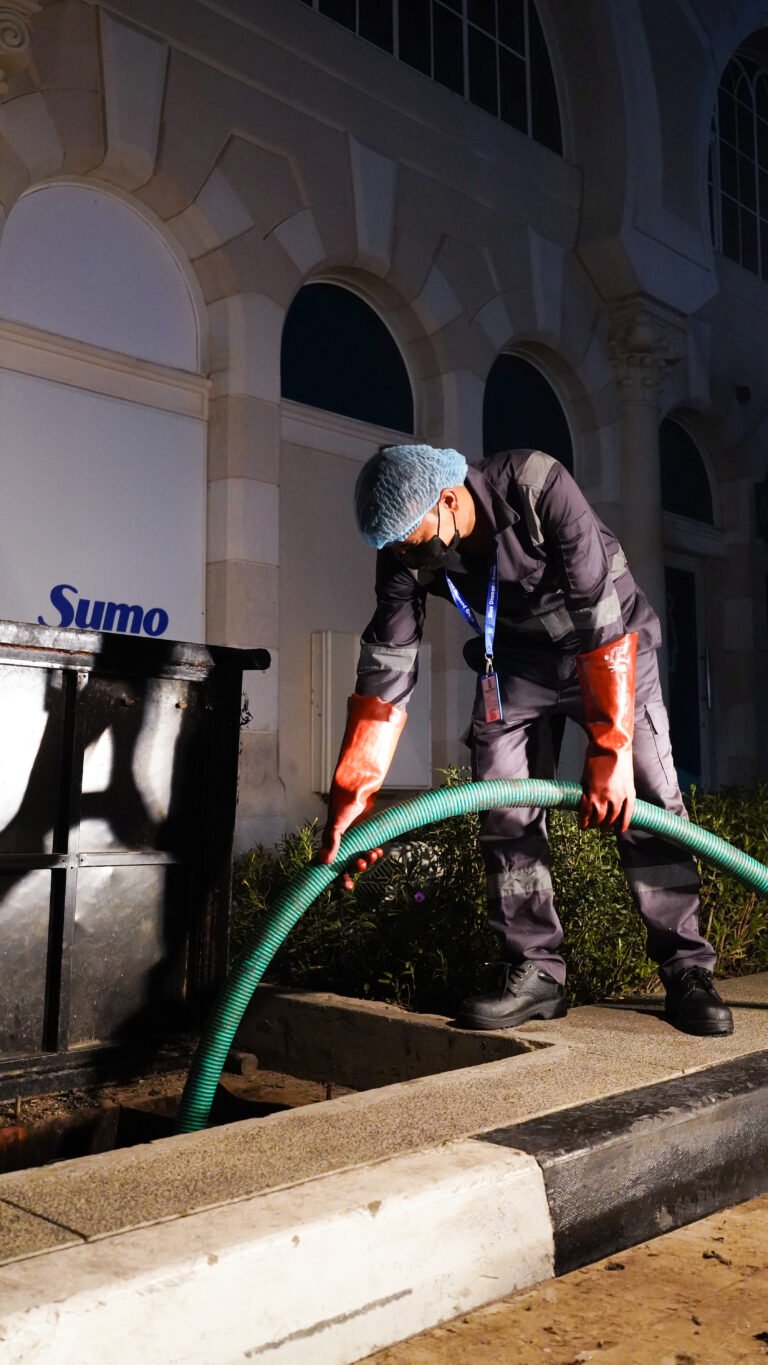
- Full pump-out — a licensed vacuum tanker removes all liquid waste, including the floating grease layer, the water column, and settled solids.
- Scraping and manual cleaning — remaining solid grease adhering to walls and baffles is scraped and removed. Baffles are inspected for damage.
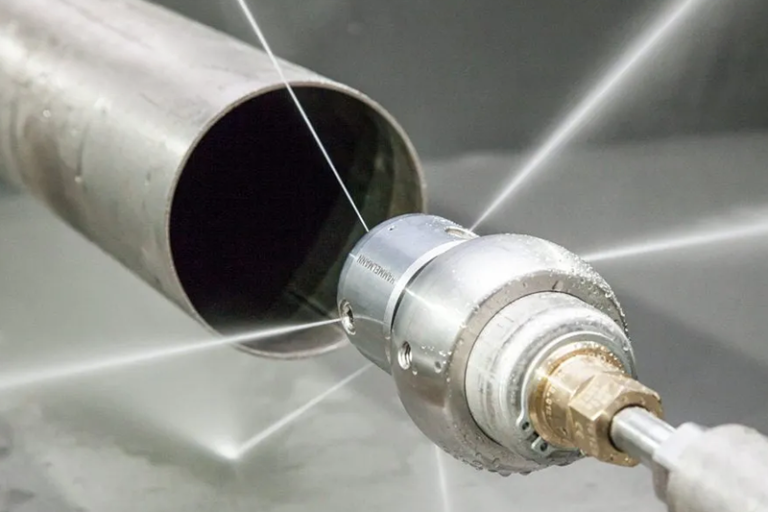
- Hot-water jetting — high-pressure hot water clears residual grease from the trap interior and connected pipework.
- Deodorizing treatment — biological or enzymatic treatment is applied to suppress gas-producing bacteria between services.
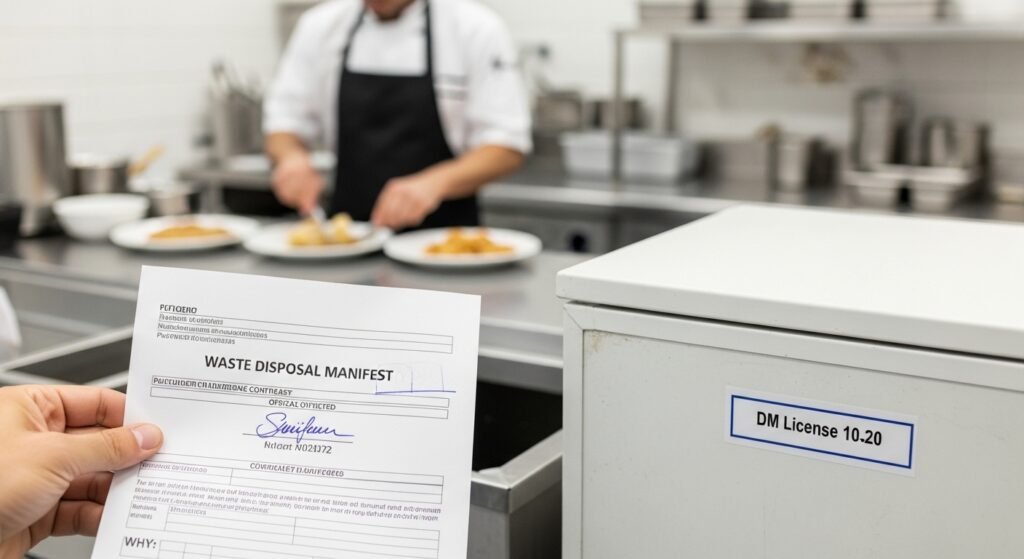
- Final inspection and documentation — technicians check baffles, inlet and outlet pipes, and issue a written service certificate with waste manifest.
Why DIY grease trap cleaning fails in the UAE
Some operators attempt DIY cleaning using chemical treatments, manual scooping, or household drain cleaning products. This approach fails for several reasons:
- Without a vacuum tanker, it is physically impossible to fully evacuate a commercial grease trap
- Chemical treatments only mask odors temporarily — they do not remove accumulated FOG
- Disposing of grease waste down the drain or in regular bins is illegal under UAE environmental regulations
- DIY cleaning produces no service certificate — your compliance file is incomplete
- Incomplete cleaning leaves the anaerobic decomposition process continuing inside the trap
The only legally compliant and operationally effective approach is professional cleaning by a licensed service provider using approved waste disposal at designated facilities.
Grease trap cleaning in UAE frequency guide for food establishments
Use this table as a starting point. Your actual required frequency may be higher depending on cooking volume, oil usage, and summer temperatures.
Establishment type | Recommended frequency | Compliance record |
High-volume restaurant (200+ covers/day) | Every 3–4 weeks | Monthly report required |
Mid-size restaurant / café | Every 6–8 weeks | Bi-monthly report |
Hotel kitchen / catering | Every 2–3 weeks | Weekly log recommended |
Cloud kitchen / dark kitchen | Every 4–6 weeks | Monthly report required |
School / hospital canteen | Every 4 weeks | Monthly report required |
Note: These are minimum recommended intervals. Speak to your cleaning provider about adjusting frequency based on your actual trap fill levels at each service visit.
How to choose a grease trap cleaning company in UAE: 5 things to check
Not all grease trap cleaning providers are equal. Here is what to verify before signing any agreement.
- Verified licensing. Municipality or authority licence — ask for the company’s trade licence and confirm they hold an environmental services permit from the relevant UAE authority. In Dubai, this means DM approval. In Abu Dhabi, ADDED or Tadweer approval. Unlicensed operators expose you to joint liability.
- Cleaning certificates. Compliance certificate on every visit — a legitimate service always issues a written service record and waste disposal manifest after each clean. This document is your evidence during municipality inspections. If a provider cannot offer this, walk away.
- 24/7 availability. Emergency response capability — grease overflows and blocked drains do not follow business hours. Confirm your provider offers 24/7 emergency response across your operating emirates.
- Multi-emirate service. Emirate-wide coverage — if you operate multiple outlets across different emirates, a single provider covering all locations simplifies compliance management and usually offers better contract rates.
- Clear pricing. Transparent, documented pricing — get a written quote specifying what is included: pump-out volume, number of visits, certificate issuance, and any surcharges for oversized traps or emergency callouts.
Protect your restaurant. Stay compliant. Stop the smell.
A neglected grease trap does not just produce unpleasant odors — it puts your hygiene certification, your customer experience, and your operating licence at risk. In UAE’s high-temperature environment, the margin for delay is smaller than in most countries.
The good news: the fix is straightforward. A professional grease trap clean takes two to three hours, produces zero disruption during off-peak hours, and comes with documented proof of compliance for your files.
Get a free grease trap inspection quote today
We service restaurants, hotels, cloud kitchens, canteens, and all commercial food establishments across all 7 emirates: Dubai | Abu Dhabi | Sharjah | Ajman | Ras Al Khaimah | Fujairah | Umm Al Quwain Same-day emergency response available. Compliance certificates issued on every visit.
Contact us today on WhatsApp | Call | Email
Phone: +971 55 996 3058
Email: info@bluediamondfm.com
Most Frequently Asked Question
Every 4 to 8 weeks for most commercial kitchens in UAE. High-volume restaurants may need monthly service, particularly during summer. This is significantly more frequent than international guidelines because UAE temperatures accelerate grease decomposition.
Yes. Dubai Municipality requires all food establishments to maintain clean, functional grease traps and to keep cleaning records available for inspection. The same requirement applies across all UAE emirates under their respective municipal authorities.
Typically, between AED 300 and AED 1,200 per service visit, depending on trap size, accessibility, volume of waste, and your location. Maintenance contracts bring the per-visit cost down by 20 to 30%. Emergency callouts attract higher rates.
Not effectively and not legally. Proper cleaning requires a licensed vacuum tanker. Disposing of grease waste improperly is an environmental violation under UAE law. Only licensed professionals can issue the compliance certificate required during municipality inspections.
A grease trap is typically smaller, installed indoors under the sink, and handles lower flow rates. A grease interceptor is larger, usually installed outdoors underground, and handles the full drainage output of a large kitchen or multiple outlets. Both require regular professional cleaning.
Warning signs include slow drains, gurgling sounds from drain pipes, persistent odors in the kitchen or dining area, visible grease overflow around the trap lid, or sewage backing up through floor drains. At any of these signs, call for emergency service immediately.
Our Services
Our step-by-step guide simplifies the cleaning process, ensuring a hassle-free experience while keeping your traps clean.
Drain Line Jetting
Pest Control Service
Deep Cleaning
business
Our Working Process
Let’s start the journey towards success and enhance revenue for your business. Take your company to the next level.
Book An Appointment Today
Blue Diamond would like to hear from you. if you have business inquiries. Get in touch with us.