Dubai Municipality Grease Trap Compliance: A 2025-2026 Guide for Restaurant Owners
Every year, Dubai Municipality conducts thousands of food establishment inspections across the emirate — and grease trap violations are consistently among the top reasons restaurants receive fines, rectification notices, and, in severe cases, temporary closure orders. If you own or manage a restaurant, cloud kitchen, hotel kitchen, cafeteria, or any food service business in Dubai, grease trap compliance is not optional. It is a legal requirement, and the cost of ignoring it far outweighs the cost of getting it right.
This guide covers everything you need to know about Dubai Municipality grease trap compliance in 2025-2026: the exact regulations, technical specifications, step-by-step approval process, maintenance obligations, and fine schedules — all in plain language designed to help you protect your business and avoid costly surprises.
The regulatory authority
Dubai Municipality’s Food Safety Department, operating under Federal Law No. 10 of 2015 on Food Safety and Dubai Municipality’s local environmental and drainage protection requirements, mandates that all food service establishments producing fats, oils, and grease (FOG) as part of their operations must install and maintain an appropriately sized grease trap or grease interceptor before wastewater enters the municipal drainage system.
This regulation exists to protect Dubai’s drainage infrastructure from blockages caused by solidified grease, which is a leading cause of sewer overflows and environmental damage. With Dubai’s rapid expansion of its hospitality and food and beverage (F&B) sector — the UAE now hosts over 30,000 registered food establishments — enforcement has intensified significantly heading into 2025-2026.
What Is Dubai Municipality's Grease Trap Regulation?
Who Needs to Comply?
he short answer is: almost any food operation that generates grease or food waste water. Dubai Municipality Grease Trap Compliance applies to restaurants, cafés, cloud kitchens, hotel kitchens, catering commissaries, food courts, and many bakeries or staff canteens with cooking activities. Even small outlets with limited food preparation may still require a compliant trap if they produce FOG (fats, oils, and grease).
The key point for property owners and facility managers is that compliance is not only a tenant issue. If the building houses an F&B operation, drainage performance, grease handling, and maintenance records can affect the wider property. That is why many commercial landlords now treat Dubai Municipality Grease Trap Compliance as part of property management risk control, not just kitchen operations.
Dubai Municipality has increased the frequency of unannounced inspections for F&B establishments since 2024, with a particular focus on newly opened restaurants and cloud kitchen operators in areas such as Al Quoz, Business Bay, and Jumeirah Lake Towers (JLT). Operators should be aware that compliance is checked not just at the point of initial licence issuance, but on an ongoing basis — meaning a grease trap that was compliant in 2023 may now require upgrading if your kitchen output has increased.
Technical Specifications: What DM Requires
Sizing your grease trap correctly:
The single most common compliance failure is undersizing. Dubai Municipality uses a capacity-based formula that takes into account the number of meals served per day and the size of the kitchen. Use the following as a general guide — always confirm exact requirements with a DM-approved contractor, as specifications can vary by zone and outlet type:
|
Daily Meal Output |
Minimum Grease Trap Capacity |
Recommended Type |
|
Up to 100 meals/day |
500 liters |
Under-sink grease trap |
|
100 – 300 meals/day |
1,000 – 1,500 liters |
Floor-mounted trap or small interceptor |
|
300 – 700 meals/day |
2,000 – 3,000 liters |
External grease interceptor |
|
700 – 1,500 meals/day |
4,000 – 6,000 liters |
External grease interceptor |
|
1,500+ meals/day |
8,000+ liters (custom) |
Large-scale external interceptor |
Note: These are indicative figures. DM inspectors will verify the calculation against your kitchen’s actual equipment list, number of sinks, dishwashers, and fryers. Always obtain a formal sizing calculation from a licensed engineer.
Approved materials
Dubai Municipality currently accepts grease traps manufactured from the following materials, provided they carry the appropriate product approval from DM’s Technical Affairs Department:
- Stainless steel (Grade 304 or 316): Preferred for indoor under-sink units due to hygiene and durability.
- Glass Reinforced Plastic (GRP / Fibreglass): Standard for large external interceptors. Must be DM-certified.
- High-density polyethylene (HDPE): Accepted for certain above-ground applications with DM approval.
- Concrete (pre-cast): Used for very large-capacity interceptors in industrial kitchen settings.
Never install an uncertified or imported grease trap without first verifying it appears on DM’s approved product register. Using a non-approved unit is itself a violation, even if it is functioning correctly.
Location and installation requirements:
- Grease traps must be installed before the kitchen’s wastewater connects to the main drainage system.
- Indoor traps must be accessible for inspection and cleaning without disrupting kitchen operations.
- External interceptors must be located outside the building footprint, with a minimum access cover at grade level.
- Adequate ventilation is required for all grease traps to prevent gas build-up.
- The unit must be clearly labelled and not obstructed by storage or equipment.
Step-by-Step: The DM Grease Trap Compliance Process
Navigating DM’s approval process can feel complex, but it follows a logical sequence. Here is exactly what you need to do:
Step 1: Engage a DM-approved contractor
Your first call should be to a contractor who is registered with Dubai Municipality’s Drainage Department. They will conduct a site visit, assess your kitchen’s FOG output, and prepare the technical sizing calculations and installation drawings required for DM submission. Do not attempt to submit drawings prepared by an uncertified party — they will be rejected.
Step 2: Submit your application to DM
Your contractor will submit on your behalf through the Dubai Municipality online portal (dm.gov.ae). Required documents typically include: completed DM application form, kitchen layout drawings, equipment schedule (fryers, dishwashers, sinks), grease trap product specifications and DM approval certificate, site location plan, and copy of your trade licence and food licence.
Step 3: DM drainage inspection
A DM drainage inspector will visit your premises to verify that the proposed installation location is appropriate and that your kitchen layout matches the submitted drawings. Inspectors check: correct positioning relative to drainage connections, adequate access for maintenance, no risk of cross-contamination with potable water supply, and structural suitability for the chosen unit.
Step 4: Installation by a licensed plumber
Once DM approves your drawings, installation must be carried out by a licensed plumbing contractor. Your approved contractor can typically arrange this. Do not install the unit before receiving written approval — doing so creates a non-compliant installation even if the unit itself is the right product.
Step 5: Final DM inspection and NOC issuance
After installation, DM will conduct a final inspection. If satisfied, they issue a No Objection Certificate (NOC) and update your establishment’s compliance record. This NOC should be kept on your premises at all times — inspectors may request it during routine visits.
Step 6: Ongoing maintenance and record-keeping
Compliance does not end at installation. You are legally required to maintain the unit, arrange regular cleaning by a DM-licensed waste hauler, and keep detailed records of all cleaning activities. These records must be available for inspection at any time. See Section 5 for full maintenance requirements.
Annual renewal
Your grease trap compliance is tied to your food license renewal. DM may request updated maintenance records and, in some cases, a re-inspection at renewal time — especially if your kitchen output has changed significantly since the original approval.
Fines, Penalties and Enforcement Actions
What DM inspectors look for
Dubai Municipality food inspectors conduct both scheduled and unannounced inspections. Grease trap compliance is a standard item on every commercial kitchen inspection checklist. Violations are identified through: absence of a grease trap, use of an unapproved or undersized unit, failure to maintain cleaning records, evidence that the grease trap has not been cleaned (overflow, blockage, odour), and connection to the drainage system without DM approval.
Fine schedule (indicative)
|
Violation Type |
First Offence (AED) |
Repeat Offence (AED) |
Escalation Risk |
|
No grease trap installed |
Up to AED 5,000 |
Up to AED 10,000+ |
Closure notice possible |
|
Unapproved / non-certified unit |
Up to AED 3,000 |
Up to AED 6,000 |
Mandatory replacement order |
|
Undersized grease trap |
Up to AED 3,000 |
Up to AED 5,000 |
Upgrade notice issued |
|
No maintenance records |
Up to AED 2,000 |
Up to AED 4,000 |
Warning + follow-up inspection |
|
Blocked / overflowing unit |
Up to AED 5,000 |
Up to AED 10,000+ |
Immediate closure order |
Note: Fine amounts are subject to change. Always confirm the current schedule with Dubai Municipality directly. Fines are compounded by the cost of emergency rectification works, which — when carried out under a DM enforcement notice — must often be completed within very tight deadlines, significantly increasing contractor costs.
The real cost of non-compliance
Beyond the direct fines, the business cost of a non-compliance event is substantial. A temporary closure order during a busy trading period can cost a restaurant tens of thousands of dirhams in lost revenue. Additionally, violations become part of your establishment’s DM inspection record, meaning future inspections will be conducted more frequently and with greater scrutiny. In the competitive Dubai F&B market, a public closure notice can also cause lasting reputational damage.
Ongoing Maintenance and Cleaning Requirements
Mandatory cleaning frequency
Dubai Municipality requires that grease traps be cleaned at a frequency appropriate to their load. As a general rule:
|
Kitchen Volume |
Minimum Cleaning Frequency |
|
Low volume (under 100 meals/day) |
Monthly |
|
Medium volume (100 – 500 meals/day) |
Fortnightly (every 2 weeks) |
|
High volume (500 – 1,500 meals/day) |
Weekly |
|
Very high volume (1,500+ meals/day) |
Twice weekly or more |
These are minimum frequencies. Your DM-approved contractor should recommend a schedule based on your specific equipment and menu — a restaurant with heavy frying operations, for example, will accumulate FOG far faster than a salad bar.
Using a DM-licensed waste hauler
This is a critical point that many restaurant operators overlook. You must use a waste hauler who is licensed by Dubai Municipality to collect and dispose of grease trap waste. Using an unlicensed hauler — even if they are cheaper — constitutes a separate violation and will invalidate your compliance record. Ask your hauler for their current DM licence number and verify it on the DM portal before engaging them.
Record-keeping requirements
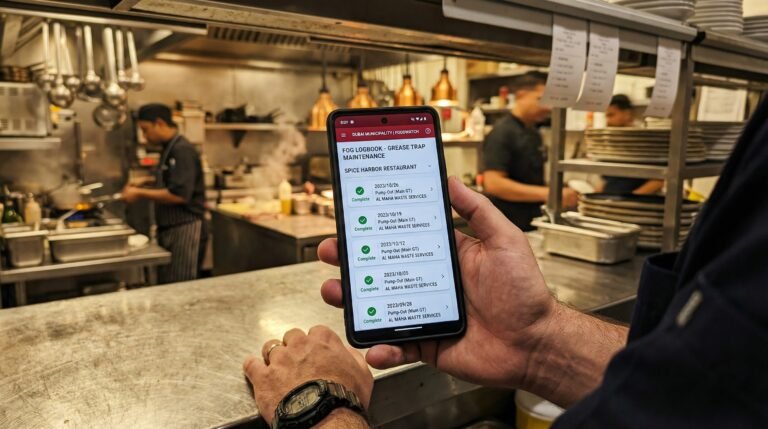
For every cleaning service, you must retain the following documentation for a minimum of two years and make it available on request during any DM inspection:
- Date and time of cleaning
- Name and DM licence number of the waste hauler
- Volume of waste removed (in litres or kg)
- Waste disposal manifest (confirming legal disposal at an approved facility)
- Signature of the responsible person at your establishment
Warning signs that your grease trap needs immediate attention
Do not wait for a scheduled cleaning if you observe any of the following — call your service contractor immediately:
- Foul or sulphurous odour in the kitchen or surrounding area
- Slow or gurgling drainage from kitchen sinks
- Visible grease or residue around drain covers
- Backflow of water from floor drains
- Unusual sounds from the drainage system
Typical maintenance costs in Dubai (2025)
Grease trap cleaning costs in Dubai vary based on unit size and frequency. As a rough guide: under-sink unit cleaning ranges from AED 200 to AED 500 per service, medium external interceptor cleaning ranges from AED 500 to AED 1,500 per service, and large-capacity interceptors can cost AED 2,000 or more per service. Annual maintenance contracts (which include scheduled visits, emergency call-outs, and record-keeping support) typically range from AED 3,000 to AED 15,000 depending on your kitchen volume.
Protect Your Restaurant — Act Before the Inspector Does
Dubai Municipality grease trap compliance is one of the non-negotiable foundations of operating a legitimate food service business in the UAE. The regulations are clear, the enforcement is active, and the consequences of non-compliance — fines, closure notices, emergency rectification costs, and reputational damage — are entirely avoidable.
The good news is that compliance is straightforward when you work with the right professionals. Getting your grease trap correctly specified, DM-approved, installed, and maintained is a one-time investment that protects your trade licence, your drainage system, and your business reputation for years to come.
Whether you are opening a new restaurant, expanding an existing kitchen, or concerned that your current grease trap setup may not meet 2025-2026 DM standards, the smartest move is to get a professional compliance assessment before an inspector does it for you.
Get a Free Grease Trap Compliance Audit
Our DM-approved team covers Dubai, Sharjah, Abu Dhabi and all across the UAE.
We handle site assessment, DM drawings, installation, NOC and ongoing maintenance — end to end.
Contact us today on WhatsApp | Call | Email
Phone: +971 55 996 3058
Email: info@bluediamondfm.com
Most Frequently Asked Question
Yes. Dubai Municipality's regulations apply to all food service establishments that produce fats, oils, and grease as part of their cooking operations, regardless of size. Even a small cafe with a single fryer or commercial dishwasher is required to have an appropriately sized grease trap. The size of the required unit will be smaller for a low-volume operation, but the regulatory obligation is the same.
The required size depends on your daily meal output, the number and type of cooking appliances (fryers, woks, commercial dishwashers), and the number of sinks in your kitchen. A small cafe serving fewer than 100 meals per day may need only a 500-litre under-sink unit, while a large hotel kitchen can require a 10,000-litre external interceptor. Always get a formal sizing calculation from a DM-approved contractor before purchasing or installing any unit.
Installation costs vary widely. A small under-sink grease trap unit, including supply and installation, can range from AED 2,000 to AED 6,000. A medium external grease interceptor installation typically costs AED 8,000 to AED 25,000. Large-capacity systems for hotel or high-volume restaurant kitchens can cost AED 30,000 or more. These figures exclude DM application fees, which are typically AED 500 to AED 2,000 depending on the type of application.
Dubai Municipality requires cleaning at a frequency proportional to your kitchen's FOG output — typically ranging from monthly for low-volume operations to twice weekly for very high-volume kitchens. Your DM-approved contractor should recommend a specific schedule. The key requirement is that cleaning is performed by a DM-licensed waste hauler and that full records are maintained.
Fines for not having a compliant grease trap can reach AED 5,000 for a first offence, with higher fines and potential closure orders for repeat violations or cases where the drainage system has been damaged. The actual fine amount depends on the severity of the violation and whether it is a first or repeat offence. Beyond fines, operators face the cost of emergency installation under a rectification notice, which is typically far more expensive than planned, proactive installation.
You cannot self-install a grease trap and achieve DM compliance. The installation must be designed by a licensed engineer, submitted through the DM portal by an approved contractor, inspected by a DM drainage inspector, and installed by a licensed plumber. Self-installation without DM approval is treated as a violation, even if the unit itself is the correct type and size.
Our Services
Our step-by-step guide simplifies the cleaning process, ensuring a hassle-free experience while keeping your traps clean.
Drain Line Jetting
Pest Control Service
Deep Cleaning
business
Our Working Process
Let’s start the journey towards success and enhance revenue for your business. Take your company to the next level.
Book An Appointment Today
Blue Diamond would like to hear from you. if you have business inquiries. Get in touch with us.