
Best Grease Trap Cleaning Company in Dubai: How to Choose the Right Contractor
Search for the best grease trap cleaning company in Dubai and you’ll find dozens of providers all using the same word about themselves. Every one claims to be fast, licensed, affordable and compliant. For a restaurant owner or facilities manager, the real question isn’t who calls themselves the best — it’s how to tell, before signing anything, which contractor will actually keep your kitchen compliant, your drains flowing and your trade licence safe.
This guide gives you a practical framework: the credentials that matter, the questions that separate professionals from pretenders, the red flags that should end a conversation, and how to compare quotes so you’re judging scope rather than just price.
Grease trap cleaning looks like a simple, commoditized service: a truck arrives, the trap is emptied, the truck leaves. But the contractor you choose affects far more than a single visit:
- Compliance exposure: Dubai Municipality and free-zone authorities inspect grease management, and the paperwork a contractor provides is your evidence.
- Waste liability: If grease is dumped improperly, regulators can trace it back to the premises that generated it, not just the contractor who collected it.
- Operational continuity: A contractor who misses visits or arrives late creates the overflow and odor problems you hired them to prevent.
- Hidden costs: The cheapest quote often excludes the steps that matter, then adds charges later.
Choosing the best grease trap contractor, then, is mostly about verifying process and paperwork, not comparing hourly rates.
Why the Choice of Contractor Matters More Than It Looks
1. Valid Trade Licence for the Right Activity
Ask for a copy of the company’s trade licence and confirm the listed activities actually cover waste collection or drainage and grease trap services. A licence for general cleaning or maintenance doesn’t automatically authorise FOG waste handling.
2. Authorised FOG Waste Collection and Disposal
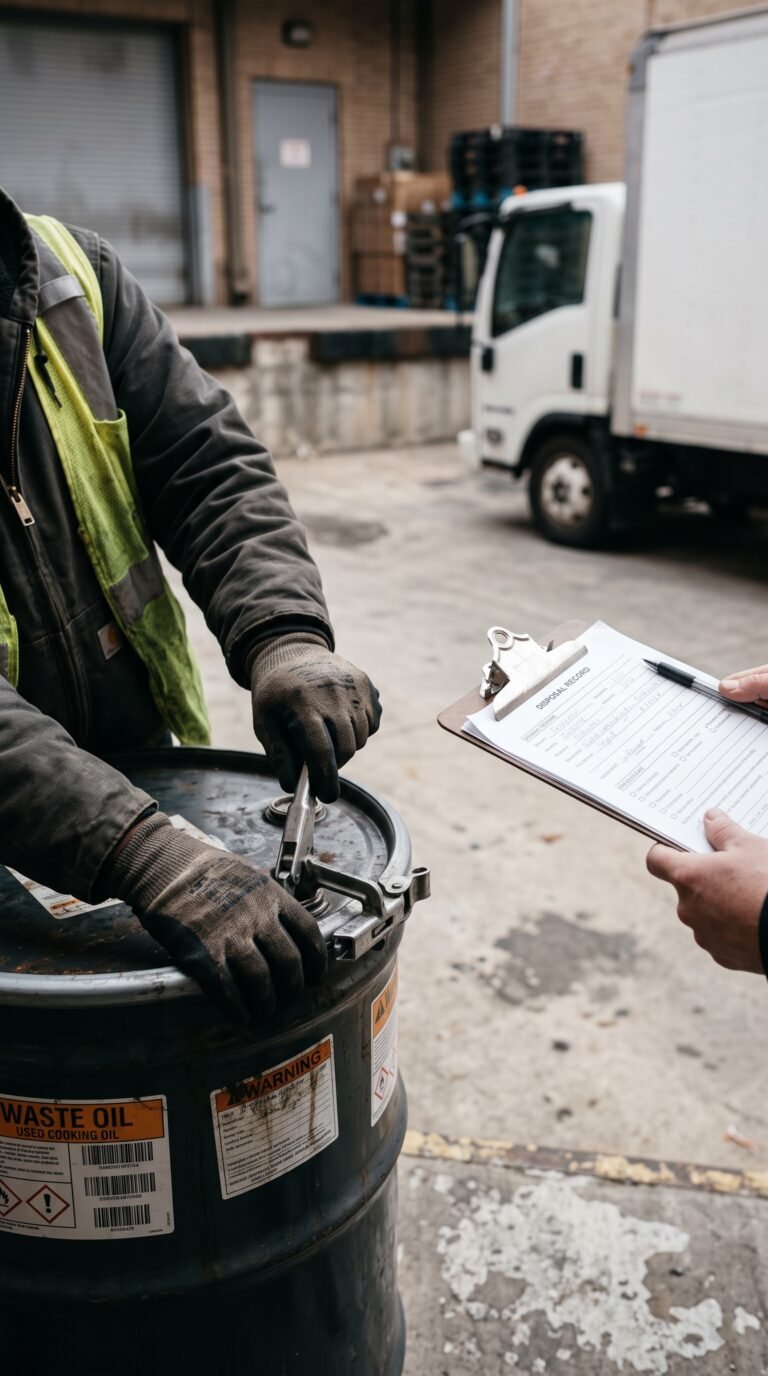
This is the single most important credential. Fats, oils and grease must be transported and disposed of through an authorised channel. Ask:
- Where does the collected waste go?
- Can you show a disposal or transfer manifest from a previous job?
- Is the disposal facility one that is approved to receive this waste?
A contractor who gets vague here is a liability to your business.
3. Documentation After Every Visit
You should receive a dated service report and disposal record each time, ideally with before-and-after photographs. This paperwork is what you present to inspectors and auditors, and it should arrive as standard, not on request.
The 10-Point Checklist for Choosing a Grease Trap Cleaning Company
4. A Scope That Goes Beyond Skimming
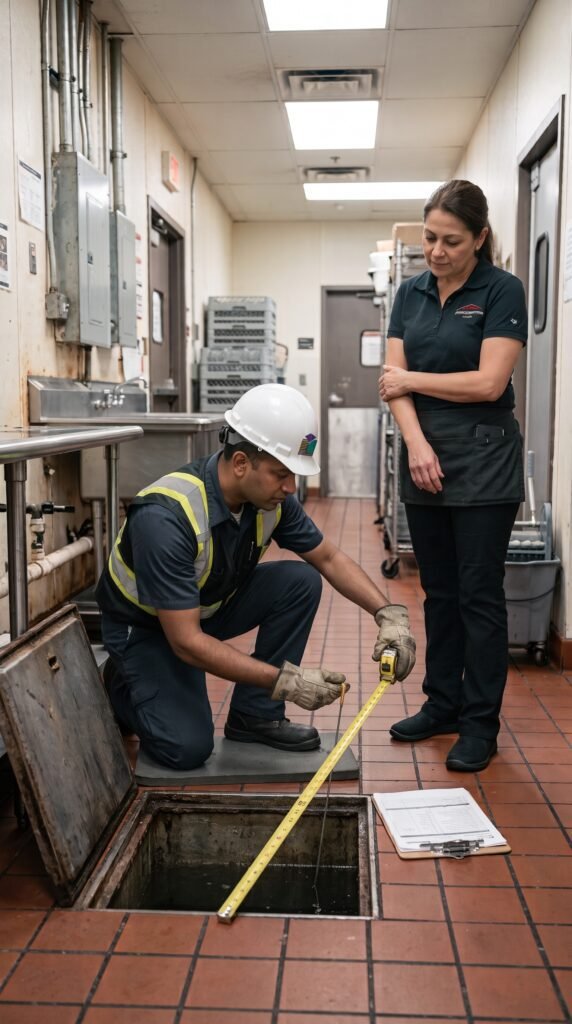
A full service includes pumping out liquid and solids, removing the grease cap, scraping walls and baffles, flushing inlet and outlet lines, and inspecting the unit’s condition. Ask for the scope in writing and compare it line by line against other quotes.
5. Experience With Your Type of Kitchen and Building
A contractor comfortable with ground-floor restaurants may struggle with a high-rise tower unit, a mall food court or a hotel kitchen, each of which has its own access and approval requirements. Ask for references from sites similar to yours.
6. Familiarity With Local Authority Requirements
Dubai has overlapping regulatory environments: mainland areas under Dubai Municipality, plus free zones and master-planned areas with their own authorities. A strong contractor can tell you which applies to your premises and what inspectors there expect to see.
7. Scheduling Reliability and Response Times
Ask how scheduled visits are managed, what happens if a visit is missed, and how quickly they respond to urgent overflow situations. A written service-level commitment is better than a verbal assurance.
8. Insurance Coverage
Confirm the company carries public liability insurance appropriate to working inside commercial premises. If something is damaged during a service, you want a contractor who can cover it.
9. Equipment and Personnel
Ask about the vehicles and equipment used and whether technicians are trained, uniformed and identifiable. Well-run operators are happy to explain their process; evasiveness is informative.
10. Transparent, Itemised Pricing
An honest quotation breaks down what you’re paying for and states whether the price is per visit or per contract. See our guide to grease trap cleaning quotes for the factors that explain why prices differ so widely between providers.
Questions to Ask Every Contractor
Use these as a script when you call or meet:
- Can you show your trade license and confirm it covers this activity?
- Where does the collected grease go, and can I see a disposal manifest?
- What exactly is included in each visit?
- What documentation will I receive after every service?
- How do you handle sites like mine (high-rise, mall unit, hotel kitchen)?
- What happens if you miss a scheduled visit?
- How quickly can you respond to an emergency overflow?
- Do you carry public liability insurance, and can I see the certificate?
- Can you provide references from comparable kitchens?
- Is your price per visit or per annual contract, and what’s excluded?
A contractor who answers these clearly and without defensiveness is already ahead of most of the market.
Red Flags That Should Make You Walk Away
- Reluctance to show licences or insurance: Legitimate operators provide these readily.
- No clear answer on disposal: “We take care of it” is not an answer.
- A price far below every other quote: for the same scope, which almost always means something has been left out.
- No written scope or itemised quotation.
- No documentation after service: leaving you with nothing to show an inspector.
- Pressure to sign immediately: or pay a large sum upfront.
- No site visit before quoting: a fixed price for a complex kitchen.
- Vague claims: like “best in Dubai” with no references, licenses or specifics behind them.
Comparing Contractors Side by Side
Build a simple comparison table before you decide:
| Criteria | Contractor A | Contractor B | Contractor C |
|---|---|---|---|
| Valid license for FOG waste activity | |||
| Disposal manifest provided | |||
| Certificate and photos after each visit | |||
| Full scope (pump-out, scraping, flushing, inspection) | |||
| Experience with similar premises | |||
| Insurance certificate seen | |||
| Response time in writing | |||
| Price: per visit / per annual contract | |||
| References checked |
Fill it in from actual documents and conversations, not website claims. The right choice is usually obvious once the gaps are visible.
One-Off Cleaning vs. an Annual Maintenance Contract
For almost every commercial kitchen, a scheduled annual maintenance contract (AMC) is the better model. Visits happen on a fixed interval before the trap becomes a problem, per-visit pricing is typically lower than ad-hoc rates, and documentation builds up automatically into the compliance record you need. Ad-hoc service suits only genuine emergencies or very low-use outlets. When comparing providers, ask what the AMC includes, how emergency call-outs are handled within it, and how reminders and records are managed.
How Often Should a Dubai Restaurant Clean Its Grease Trap?
| Kitchen Type | Typical Interval |
|---|---|
| High-volume fried or grilled cuisine | Every 2–4 weeks |
| Standard full-service restaurants | Every 4–6 weeks |
| Cafés and low-oil-output outlets | Every 6–8 weeks |
| Cloud kitchens with multiple brands | Every 2–4 weeks |
Your approved conditions or authority guidance may specify an interval, so follow that where it applies, and ask your contractor to base the schedule on your actual grease output rather than a generic calendar.
Choose on Evidence, Not Claims
The best grease trap cleaning company in Dubai for your kitchen is the one that can prove its licence, show where your waste goes, document every visit, and show up when it says it will. Use the checklist and questions above to test every contractor on the same terms, and let the paperwork, not the slogan, decide.
Request a transparent, itemised quotation. Blue Diamond team will assess your trap, explain exactly what each visit includes, show our licensing and disposal documentation up front, and set up a documented cleaning schedule for your kitchen anywhere in Dubai.
Contact us today on WhatsApp | Call | Email
Phone: +971 55 996 3058
Email: info@bluediamondfm.com
Most Frequently Asked Question
Ask for their trade license and check that the listed activities cover waste collection or drainage services. Also ask for evidence of authorized disposal, since the license alone doesn't prove how waste is handled after collection.
Rarely. Very low quotes usually reflect a reduced scope, missing documentation or questionable disposal. Compare the full scope and paperwork before comparing price.
Neither is automatically better. Size matters less than licensing, authorized disposal, documentation, reliability and relevant experience. Judge both against the same checklist.
Many can, and a single provider with consistent reporting simplifies compliance for multi-site operators. Confirm they have coverage and capacity across your locations and understand each site's authority requirements.
This should be covered in your agreement: how quickly a replacement visit is arranged, and whether any penalty or credit applies. Ask before signing, not after the first missed visit.
Our Services
Our step-by-step guide simplifies the cleaning process, ensuring a hassle-free experience while keeping your traps clean.
Drain Line Jetting
Pest Control Service
Deep Cleaning
business
Our Working Process
Let’s start the journey towards success and enhance revenue for your business. Take your company to the next level.
Book An Appointment Today
Blue Diamond would like to hear from you. if you have business inquiries. Get in touch with us.