Grease Trap Services Business Bay & Downtown Dubai: What High-Rise Kitchens Need
Business Bay and Downtown Dubai concentrate more high-rise F&B outlets per square kilometer than almost anywhere else in the emirate — towers stacked with restaurants, hotel kitchens, cloud kitchens and café units, all sharing vertical service risers, basement waste rooms, and building management rules that a ground-floor standalone restaurant never has to think about. Grease trap services Business Bay & Downtown Dubai aren’t just a smaller version of the same job done at street level — the vertical building context changes sizing, access, scheduling and compliance in ways that catch a lot of F&B operators off guard.
This guide covers what’s actually different about running a compliant grease trap program inside a Business Bay or Downtown tower, and what to check before you sign with a contractor.
A standalone restaurant with its own external service yard can install a grease trap wherever site logistics allow, with direct vehicle access for pump-out. A restaurant on the 3rd floor of a Business Bay tower, or in a Downtown mall unit with shared back-of-house corridors, works within constraints the building itself imposes:
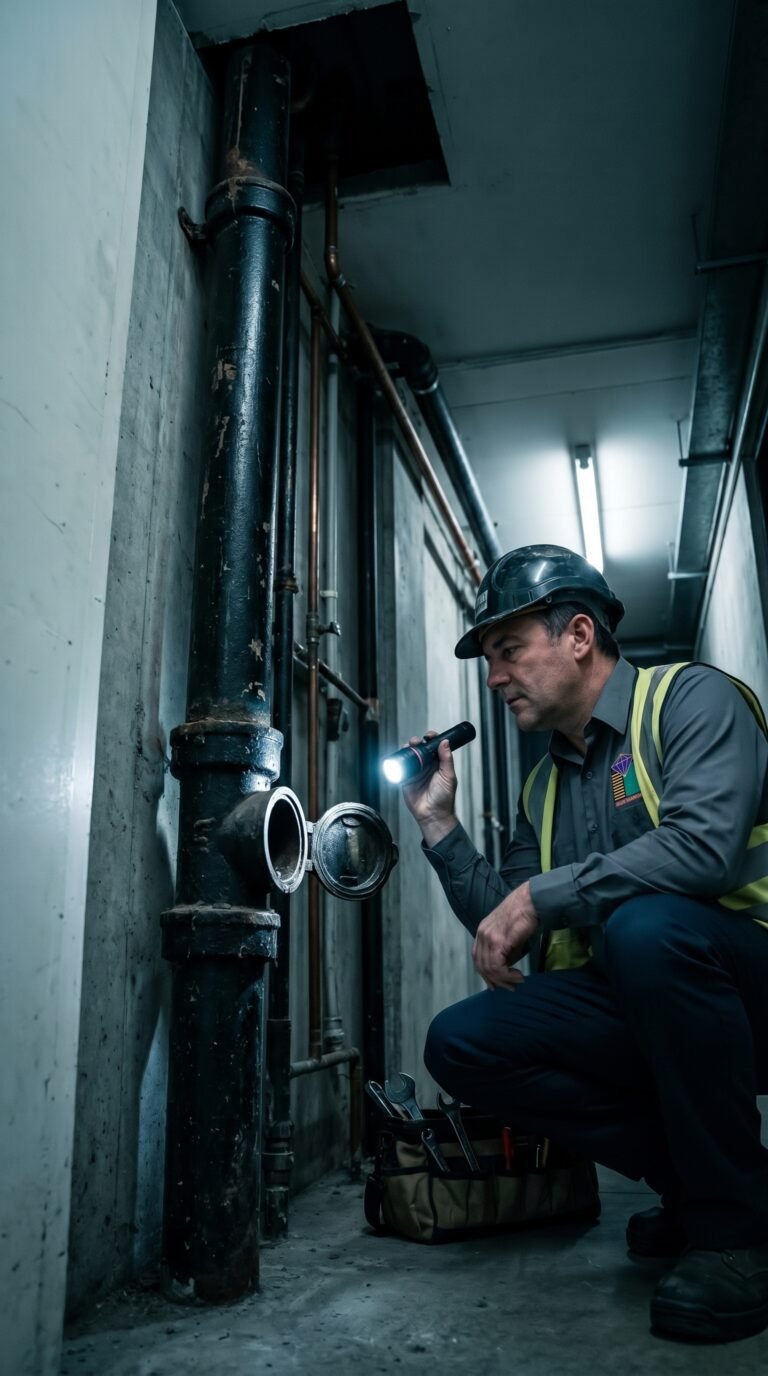
Shared vertical drainage: Multiple F&B units on different floors often discharge into the same drainage riser. One under-maintained trap upstream can cause blockages and backflow affecting tenants below — building management treats this as a shared-infrastructure risk, not just one tenant’s problem.
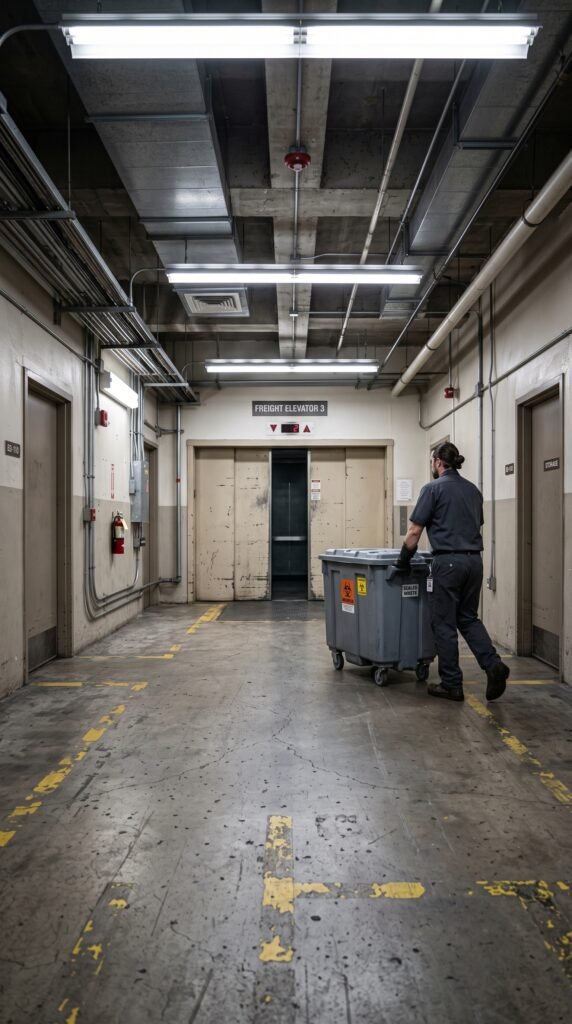
Restricted service access: Freight elevator booking windows, loading bay time slots, and building management approval for any contractor entering service corridors all add scheduling layers a ground-floor restaurant doesn’t face. Pump-out trucks generally can’t reach a 12th-floor kitchen directly — waste has to be moved down through the building via designated routes.
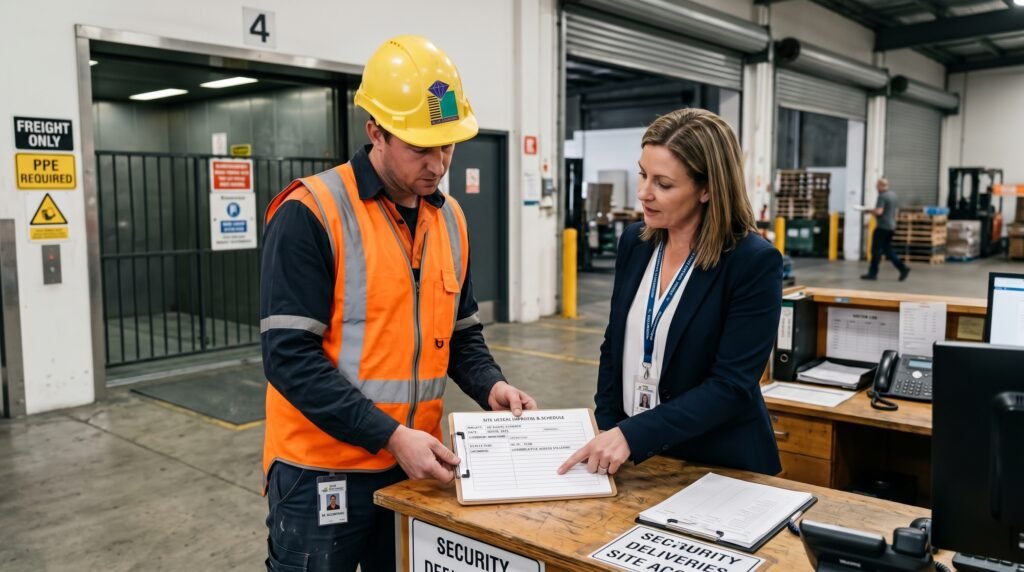
Building management sign-off: Most Business Bay and Downtown towers require contractors to be pre-approved by building/facilities management before they can access service areas, and some mandate specific access hours to avoid disrupting other tenants or building operations.
Space constraints: High-rise kitchen footprints are typically tighter than standalone restaurants, and grease traps have to be sized and positioned within genuinely limited plant space — sometimes requiring compact or under-counter-adjacent units engineered specifically for the available footprint.
Multi-authority overlap: Depending on the exact tower and zone, you may be dealing with Dubai Municipality, the relevant free zone authority (DIFC-adjacent developments fall under different rules than mainland Business Bay), and building management requirements simultaneously.
Why High-Rise Kitchens Are a Different Problem
Sizing Grease Traps for High-Rise Kitchen Footprints
Grease trap services Business Bay & Downtown Dubai towers almost always involve a sizing conversation shaped by available plant space rather than kitchen output alone. A ground-floor restaurant can typically fit whatever size the wastewater volume calls for; a high-rise kitchen often has to work backward from a fixed plant room footprint the landlord allocated during shell design.
Key sizing factors specific to tower kitchens:
- Available plant room dimensions (frequently the binding constraint, not kitchen output)
- Number of F&B units sharing the same drainage riser
- Peak service hours and covers per day
- Whether the unit can support a compact/high-capacity trap design versus a larger standard footprint
A contractor unfamiliar with high-rise constraints will often quote a standard ground-floor sizing that simply doesn’t fit the available plant space — always confirm your contractor has measured the actual installation footprint before quoting.
Access, Scheduling and Building Management Coordination
This is where high-rise grease trap servicing diverges most from standalone restaurant service:
Freight elevator booking: Pump-out equipment and waste containment typically has to move through the building’s freight elevator, which means coordinating a booking slot with building management — sometimes days in advance for busier towers.
Approved contractor lists: Many Business Bay and Downtown towers maintain a pre-approved contractor list for any service work in shared areas. Using an unlisted contractor can mean access is simply refused at the loading bay, regardless of how good the service itself is.
Off-peak service windows: Building management commonly restricts service and waste-movement activity to specific hours — often late evening or early morning — to avoid conflicts with retail, office and residential traffic through shared lobbies and loading areas.
Waste routing through shared corridors: Contractors need a documented route from the kitchen to the loading bay that respects fire corridor regulations and doesn’t obstruct emergency egress paths, which building management will typically need to review and approve.
Insurance and liability documentation: Given the shared-infrastructure risk profile, towers frequently require contractors to hold public liability insurance meeting a minimum coverage threshold before granting building access.
Compliance Considerations Specific to the Area
Grease trap services Business Bay & Downtown Dubai operate under overlapping compliance layers depending on the exact building and zone:
Dubai Municipality Food Safety Department: requirements apply to the large majority of F&B outlets across mainland Business Bay and Downtown, covering installation, sizing and documented maintenance in line with standard Dubai Municipality expectations.
DIFC and free-zone adjacencies: Some Downtown-adjacent developments fall within DIFC or other free-zone jurisdictions with their own environmental health inspection regimes — if your unit sits within one of these zones, Municipality compliance alone isn’t sufficient; check which authority actually holds jurisdiction over your specific building.
Building-specific fit-out guidelines: Nearly every major Business Bay and Downtown tower has its own F&B fit-out manual specifying MEP requirements, including grease trap placement, materials and access provisions, that go beyond baseline Municipality requirements. These are enforced by building management independently of government inspections.
Shared liability exposure: In a shared drainage riser scenario, a documented, regularly serviced grease trap isn’t just about your own compliance — it’s your evidence if a drainage failure affecting multiple tenants is ever disputed over which unit caused it.
What to Look For in a High-Rise Grease Trap Contractor
Not every grease trap company is equipped to work in Business Bay and Downtown towers. Use this checklist:
- Demonstrated experience with high-rise/tower F&B units: not just ground-floor restaurants
- Familiarity with building management approval processes: can they name the specific coordination steps without hesitation?
- Flexible off-peak scheduling: matching your building’s access windows
- Public liability insurance: meeting typical tower minimum-coverage requirements
- Compact/space-efficient equipment: suited to constrained plant rooms
- Documented waste routing plans: that respect fire corridor and egress rules
- Multi-authority compliance awareness: — able to confirm which authority (Municipality, DIFC, or another) governs your specific building
- References from other tenants in comparable Business Bay or Downtown towers
Recommended Service Frequency for Tower Kitchens
| Kitchen Type | Typical Frequency in High-Rise Settings |
|---|---|
| High-volume restaurant/hotel F&B | Every 2–4 weeks |
| Standard casual dining or café | Every 4–6 weeks |
| Cloud kitchen with multiple brands | Every 2–4 weeks (combined FOG load) |
| Low-volume beverage/light-prep unit | Every 6–8 weeks |
Shared riser exposure is a strong argument for erring toward the more frequent end of these ranges — an overdue trap in a shared drainage system creates risk for neighbouring tenants, not just your own kitchen.
Keep Your Restaurant Licence Protected
Grease trap services Business Bay & Downtown Dubai towers demand more coordination than a standalone restaurant ever requires — building management approval, freight elevator scheduling, shared-riser risk, and sometimes overlapping authority jurisdiction all have to work together for service to actually happen on time.
Book a free site assessment, Blue Diamond team has direct experience navigating Business Bay and Downtown building management requirements, from sizing your unit’s grease trap to coordinating access and keeping your compliance documentation audit-ready.
Contact us today on WhatsApp | Call | Email
Phone: +971 55 996 3058
Email: info@bluediamondfm.com
Most Frequently Asked Question
Not necessarily a different type, but often a different size and configuration — high-rise plant rooms frequently constrain the footprint available, requiring compact or space-efficient units engineered to fit rather than a standard ground-floor design.
Waste is moved from the kitchen to the loading bay via designated internal routes — typically the freight elevator during a booked service window — rather than direct external vehicle access, which is why building management coordination is essential.
The core Dubai Municipality requirements are broadly the same across both areas, but some Downtown-adjacent buildings fall within DIFC or other free-zone jurisdictions with separate compliance regimes — always confirm which authority governs your specific building rather than assuming.
Blockages typically affect every F&B unit discharging into that riser, not just the outlet responsible. Building management will usually investigate to identify the source, and a documented, regularly serviced grease trap is your evidence that your unit wasn't the cause.
This depends on your building's freight elevator and loading bay booking system — busier towers may require several days' notice for a service slot, so building the booking lead time into your maintenance schedule (rather than treating it as reactive) avoids service delays.
Our Services
Our step-by-step guide simplifies the cleaning process, ensuring a hassle-free experience while keeping your traps clean.
Drain Line Jetting
Pest Control Service
Deep Cleaning
business
Our Working Process
Let’s start the journey towards success and enhance revenue for your business. Take your company to the next level.
Book An Appointment Today
Blue Diamond would like to hear from you. if you have business inquiries. Get in touch with us.